Wednesday, August 26, 2015

Hackers vs. Drones: ISIS Cyber Caliphate Leader Junaid Hussain

In what may be a first move in the new escalation of cyber warfare with kinetic results, Junaid Hussain, the 20-something hacker who fled to ISIS after being charged with hacking Tony Blair's email accounts, has been killed by a drone strike.

CNN is running with the exclusive at this time claiming "The U.S. military and intelligence community is in the final stages of confirming that a U.S. drone strike this week killed Junaid Hussain."

(Click for CNN Story)

CNN quotes "several U.S. officials" that "the drone strike was specifically targeting Hussain traveling in a vehicle in Syria after the U.S. got intelligence on where he was and watched him to confirm his presence before striking."

Those who follow the defacement community will be well-familiar with Hussain's previous shenanigans online as the leader of Team Poison.  He gradually drifted from target-of-opportunity defacing to more difficult "called target" defacing, and was eventually jailed at age 18 by the British government after publishing the details of Tony Blair's email accounts, as broadly documented in July of 2012.

Click for Telegraph story

Hussain, who hacked under the name "Trick" during his Team Poison days in England, was sentenced to six months imprisonment for "conspiring to commit public nuisance," "causing a computer to perform a function to gain unauthorized access to data or programs" and "defacing numerous websites" between January 1, 2010 and April 14, 2012.  After his release he was arrested again for his cyber activities and fled the country while out on bail.

2012 - TeaMp0ison hacks NATO
 Hacking governments and militaries was something TeamPoison (TeaMp0isoN) had been doing for years prior to Trick's run-in with the UK authorities.  Above is a typical rant from Trick decrying NATO, BAE Systems, BP Oil, and Rupert Murdoch.

On August 3, 2015, the Mirror ran the headline "ISIS: British computer hacker who fled to Syria is third on US hit list of key Islamist militants".  At that time, he was using his new jihadi-friendly hacking name of "Abu Hussain al-Britani".  According to the Mirror article, only Jihadi John (Mohammed Emwazi) and ISIS Leader Abu Bakr al-Baghdadi were more wanted on the US "kill list."

Among his crimes, Hussain was identified as the man suspected in hacking the Twitter and Facebook accounts of US Central Command.Their most recent Twitter accounts @UmmHussain_18 and @AbuHussain_23 were created after their August 13th leak of US government personnel contact information caused #17 and #22 to be deleted by Twitter.

His 45-year-old rock-musician wife Sally Jones, now "Umm Hussain Al-Britani" and their 10-year-old son also lived with him in Syria.  As of 14AUG2015, there was concern that she may have been seen back in England:

Click for "Mrs. Terror Back in Britain?"


Tuesday, August 25, 2015

The Case of Spamford Wallace: Guilty at Last!

My anti-spam community friends were all abuzz today with the news that Spamford Wallace had pleaded guilty in a Las Vegas court to "compromising approximately 500,000 Facebook accounts" in order to deliver "more than 27 million spam messages."

What might amaze the General Reader is that this is the SAME Spamford Wallace case that began with an indictment on July 6, 2011.

The Spamford Wallace Indictment


July 6, 2011 Original Charges

According to the Indictment, Wallace created an account on November 4, 2008 under the name "David Frederix" and then tested posting spam messages to his 'real' wall "Sanford MasterWeb Wallace" experimenting with which posts would best evade Facebook's filters.

He then made a script that would automate the process of logging in to a Facebook account, obtaining a list of all of the Friends of that account, and then posting his advertising message to each of those friends' walls.  Spamford then created a domain registrar account at Moniker Online and another at Dynadot (using the name Laura Frederix) and between the two created 2,500 domain names that would be used in these spamming attacks against Facebook users.

On November 5 and 6, 2008, Sanford sent approximately 125,000 spam messages to Facebook users using this method.  On December 28, 2008, another run was made, posting nearly 300,000 spam messages, by logging in through 143 different IP addresses that were used as proxies to disguise his origins.  On February 17, 2009, another 125,000 messages were posted.

At this point, a civil injunction was served on Sanford Wallace in the case of Facebook Inc v. Sanford Wallace (Northern District of California No 09-00798 JF) where Judge Jeremy Fogel ordered Sanford Wallace to no longer access Facebook's computer network.  (Orders issued on March 2, 2009 and March 24, 2009).  Sanford logged in on April 17, 2009, in violation of this order, while flying on a Virgin Airlines flight  from Las Vegas to New York.

In 2011, Sanford was back on Facebook, using a profile called "David Sinful-Saturdays Fredericks"

Counts 1,3, 7 - Fraud and Related Activity in Connection with Electronic Mail, carry a possibility of 3 years imprisonment.

2, 6, and 9 - Intentional Damage to a Protected Computer, carries a maximum sentence of 10 years imprisonment.

4, 5 and 8 - Fraud and Related Activity in Connection with Electronic Mail, carries a 3 year imprisonment possibility, and a possible $250,000 fine.

Counts 10 and 11  - Criminal Contempt, have unspecified potential penalties.

What's Happened Since?

Lots and lots of lawyering. . . behold the process of a Fair and Speedy Trial!!!!
  • 04AUG2011 - the indictment was unsealed
  • 04AUG2011 - notice of related cases was received.  These included:
  1. the case of Facebook v. Sanford Wallace, Adam Arzoomanian, Scott Shaw, and John Does 1 through 25, for Violation of the CAN-SPAM ACT, violation of the Computer Fraud and Abuse Act, Violation of the California Business Code Section 229489 AKA the California Anti-Phishing Act, and Violation of California Penal Code section 502, the California Comprehensive Data Access and Fraud Act.  That case describes:  "At least one of the Defendants, Sanford (aka "Spamford") Wallace, is a notorious Internet scam artist who has been involved in various illegal spamming and malware activities since the mid 90s.  Indeed, Mr. Wallace has both Federal Trade Commission and civil judgements against him for these activities that total in excell of $235 million."  Myspace, Inc. v. Wallace; FTC v. Seismic Entertainment Prod., Inc; CompuServe v. CyberPromotions, Inc (Ohio, 1997)
  2. This case resulted in a Default Judgement in favor of Facebook signed by Judge Jeremy Fogel on 29OCT2009. 
  • 22AUG2011 - bail hearing
  • 28SEP2011 - case reassigned to a new Judge (Judge D. Lowell Jensen)
  • 30SEP2011 - Order to Waive Appearance proposed )amd gramted_
  • 03OCT2011 - Status hearing held
  • 04OCT2011 - case reassigned to Judge Edward J. Davila
  • 31OCT2011 - Pretrial services form 8 submitted.
  • 28NOV2011 - Status hearing held
  • 09JAN2012 - "Fair and Speedy Trial Act" exemption requested due to AUSA Attorney being engaged in another trial, and for additional time for the defendant's need for effective preparation of counsel. "The ends of justice served by granting the requested continuance outweight the best interest of the public and the defendant in a speedy trial." - extension granted until 09APR2012.
  • 02APR2012 - extended to 07MAY2012 by mutual consent.
  • and again to 06AUG2012, and again to 01OCT2012, and again to 19NOV2012
  • Status hearings held 14JAN2013, 11MAR2013
  • 11MAR2013 - hearing grants a modification to pretrial release conditions to allow Spamford to travel to Albuquerque, New Mexico for work.
  •  More delays 31MAY2013, 08AUG2013, 20SEP2013, in each case ordering that time be "excluded" from consideration in the Fair and Speedy Trial Act to allow for effective preparation for the case.
  • 02NOV2013 - Sanford's attorney (K.C. Maxwell) files a sealed document asking to be relieved from the case 09DEC2013.
  • Extension granted to 03FEB2014
  • 17MAR2014 set as the date to hear the Motion to Withdraw as Counsel.
  • Continued to 31MAR2014, when Wallace assigns his new counsel, William W. Burns, Esquire.
  • 25JUN2014 new counsel asks for more time to prepare
  • 18JUL2014 William Burns petitions the court to withdraw as counsel
  • 21JUL2014 Burns Relieved
  • 21JUL2014 a Financial affidavit is delivered to the court pertaining to Spamford Wallace
  • 01AUG2014 - "The individual named above as defendant, having testified under oaht or having otherwise satisfied this court that he or she (1) is financially unable to employ counsel and (2) does not wish to waive counsel, and because the interests of justice so require, the Court finds that the defendant is indigent, therefore, IT IS ORDERED that the attorney whose name, address and telephone number are listed below is appointed to represent the above defendant." (Wm. Michael Whelan, Jr. / 95 South Market St, Ste 300 / San Jose, CA 95113 / (650) 319-5554 cell)
  • 19AUG2014 - time extended to allow Whelan to prepare
  • 22SEP2014 Status conference held, Jury Trial date set for 05MAY2015 through 22MAY2015.
  • 29SEP2014 Whelan petitions the court that drug testing no longer be required since Sanford has never tested positive. (Granted 15OCT2014)
  • 02MAR2015, status hearing extends case until an 08JUN2015 status hearing
  • 12JUN2015 - new financial affidavit entered under seal
  • 30JUN2015 - a change of plea hearing is requested for 27JUL2015
  • 24AUG2015 - Sanford Wallace pleas guilty to a single count - Count 3.  Sentencing scheduled for 07DEC2015 at 1:30 PM

Guilty of Count Three

So, if we go back to the indictment, what does this mean that Sanford has plead guilty to?


COUNT THREE: (18 U.S.C.  §§1037(a)(1) and (b)(2)(A) - Fraud and Related Activity in Connection with Electronic Mail.

22. The factual allegations contained in Paragraphs One through Eleven above are realleged and incorporated herein as if set forth in full.

23.  On or about December 28, 2008, in the Northern of California and elsewhere, the defendant, SANFORD WALLACE, knowingly accessed a protected computer without authorization, and intentionally initiated the transmission of multiple commercial electronic mail messages from or through such computer, in and affecting interstate and foreign commerce, to wit: the defendant accessed Facebook's computer network in order to initate the transmission of program that resulted in nearly 300,000 spam messages being sent to Facebook users.


What were 1 through 11?  The only really important paragraph is number 5:

5. From approximately November 2008 through March 2009, WALLACE developed and executed a scheme to send spam messages to Facebook users that compromised approximately 500,000 legitimate Facebook accounts, and resulted in over 27 million spam messages being sent through Facebook's servers.)


Monday, August 24, 2015

Darkode guilty pleas: Phastman, Loki, & Strife


So far there have been three guilty pleas related to the Darkode hacking forum.  Although the case, which used the name "Operation Shrouded Horizon" resulted in 70 arrests worldwide, only twelve individuals have been indicted so far by the Department of Justice, and several of those individuals are overseas.  When the site was taken over, it displayed this graphic, showing the many foreign law enforcement agencies that cooperated with the takedown and the arrests.


Johan Gudmunds / Mafi

Image from ArrestTracker

The main administrator of Darkode is Johan Anders Gudmunds.  Gudmunds used three hacker aliases: Mafi, Crim, and Synthet!c.  According to DOJ, he resides in Sweden.   According to the indictment "From around September 2008 until about January 23, 2015" Gudmuns "knowingly and willfully did aid and abet and conspire, combine, confederate and agree together with other persons" ... "to commit offenses against the United States" including:

  • intentionally accessing a computer without authorization and exceeding authorized access to a protected computer, committing the offense for purposes of commercial advantage and private financial gain in furtherance of a criminal and tortious act in violation of the Constituion and the laws of the United States to obtain a thing of value exceeding $5,000 -- 18 USC Sections 1030(a)(2)(C) and (c)(2)(B)(i)-(iii).
  • knowingly and with intent to defraud accessed a protected computer and by means of such conduct intended to commit fraud or obtain something of value -- 18 USC Section 1030(a)(4) and (c)(3)(A)
  • knowingly caused the transmission of a program, information, code, and commands that as a result of such conduct intentionally caused damage affecting 10 or more protected computers during a 1-year period -- 18 USC Sections 1030(a)(5)(A) and (c)(4)(B).
  • knowingly and with intent to defraud trafficked in passwords and similar information through which a computer may be accessed without authorization affecting interstate and foreign commerce -- 18 USC Sections 1030(a)(6)(A) and (c)(2)(A).
Gudmunds wrote a botnet called "Blazebot" that compromised computers that he later sold access to. His price for access was $80 per 1,000 compromised machines, or 8 cents per computer.  Yes, that is how much your PC is worth!  Gudmunds also sold root access on computers at universities in Europe for $50 per server, and to at least 200 other servers for between $10 and $50.  The Zeus malware that he controlled logged more than 200,000,000 credential thefts from 60,000 compromised computers that made up his botnet.  (This would include many repeated credentials, obviously.)  Gudmunds also wrote an Exploit Kit called "CrimePack" that he sold on his forum, as well as an MSN Messenger spreader.  He was still authoring and selling code much more recently, including his package called "Pandemiya 2014"

Some of Gudmunds online ids included the jabber account "mafioso@xmpp.jb" and the email account "mafi@thesecure.biz".  He began using the Synthet!c alias in January 2012.


Daniel Placek / Loki

According to the Gudmunds indictment, the original Darkode.com forum was created by "Iserdo" and "nocen / Loki".  We know from the charges against Daniel Placek of Glendale, Wisconsin, that he was the one who used the aliases Nocen, Loki, Juggernaut, and M1rro0r.

Loki's charges say that "in or about June 2008, Daniel Placek and Martjaz Skorjanc (AKA Iserdo)  created the Internet forum with the domain darkode.com with the intention of bringing together computer hackers and other criminals to facilitate the production and sharing of malicious software, and later led to forum discussion about the creation and dissemination of botnets and the sending of spam."   Placek was an administrator on the forum, and in January 5, 2010, agreed to sell malware that he designed for harvesting network traffic for email addresses and passwords to a user named Dethan.78 for $500.  Dehtan.78 was an FBI agent.  Oops!

When Placek's computer was raided, all the way back in 2010, it was found to contain 74,190 credit card numbers and 297 bank account numbers.  In his guilty plea on July 31, 2015, Placek agreed to plea to one charge in exchange for prosecutors agreeing to seek a sentence of "six to twelve months".  This agreement carefully considered the fact that Placek has provided full cooperation regarding law enforcement queries and access to Darkode FOR MORE THAN FIVE YEARS!

From all reports, Placek has left his black hat ways behind him and has not participated in crime since his 2010 activities.   He has been working as a network engineer for a company named Swick Technologies, and neither law enforcement nor his employer has had any reason to doubt that he is reformed.  (More from this article:  Placek to plead guilty for role in creating Darkode hacker marketplace  )

Eric Croker AKA Phastman

Eric L. Crocker, a 39-year old resident of New York, (some sources say 29) was the first to plea guilty from the charges that came out of the Darkode forum seizure.  His primary plea is that he violated the CAN-SPAM ACT.  Phastman's primary activity that he is charged with is the creation of a hacking tool called the Facebook Spreader.  Although he is only directly charged for breaking into "at least 77,000 computers" and his indictment indicates he sold access to computers his botnets controlled for $200 to $300 per 10,000 (2 to 3 cents per machine) some news sources are reporting that his hacking earned Crocker "upwards of $21 Million." 

Phillip Fleitz, AKA Strife

Phillip Fleitz photo from ArrestTracker
 Phillip Fleitz was the most recent person to plead guilty on the Darkode case.  Fleitz is named along with two others in an indictment from the Western District of Pennsylvania.  The three were:

  • Naveed Ahmed (AKA "Nav" AKA "Semaph0re")
  • Phillip R. Fleitz (AKA "Strife")
  • Dewayne Watts (AKA "m3t4lh34d" AKA "metal"
The conspiracy that these three are charged with involves leasing at least two "bullet-proof hosting" servers in China that were used to scan Internet-connected routers to identify places that would allow them to use those routers as Proxies to reroute commercial email messages to hide their true source.  The spam that was sent was primarily using "email-to-SMS gateways" so that the emails sent would show up as text messages on cell phones of the recipients.  The spam was primarily "gift card scams" with the indictment giving the particular example of Best Buy Gift Card spam.  A couple examples include:
  • "Congratulations, your 4th place code is H7G0 - BestBuyVouchers.com"
  • "Congratulations! You've finished Fifth!  Your code is: WM154 - FreeBestBuyCards.net"
  • "Your entry placed 8 out of 10!  Claim the prize with this Code: U0V2 - BBCodeTexts.net"

Still to Come

The people who are still named by the Department of Justice, but have not yet plead guilty are:

  •     Johan Anders Gudmunds - see above
  •     Morgan C Culbertson - the "FireEye Intern" / Carnegie Mellon student
  •     Naveed Ahmed -
  •     Dewayne Watts - M3t4lh34d / metal
  •     Murtaza Saifuddin
  •     Matjaz Skorjanc - rzor from Pakistan
  •     Florencio Carro Ruiz - NetK, Netkairo from Spain
  •     Mentor Leniqi - Iceman from Slovenia
  •     Rory Stephen Guidry - selling botnets, k@exploit.im
 Of those, the only individual who has received much US-based press was Morgan, who is the author of a Remote Administration Trojan known as Dendroid.            


If any more guilty pleas come through, we'll try to update this page!

By the way, much praise to a site I was not previously familiar with called "Arrest Tracker" from the people that run CyberWarNews.info.  His page "Mass Arrest #24"  here has a great summary of what's going on with Darkode, but I know many of my readers will be interested in regularly following the regular updates from his page!


Thursday, July 23, 2015

Pump-n-Dump Spammers Arrested in Israel

A trio of Pump-n-Dump spammers have had their indictments unsealed and two have been arrested in Israel. The charges were brought against:
  • Joshua Samuel Aaron, aka Mike Shields, age 31, US Citizen living in Israel
  • Gery Shalon, aka Phillipe Mousset aka Christopher Engeham, age 31, native of Republic of Georgia, Israeli citizen
  • Zvi Orenstein, aka Aviv Stein aka John Avery, age 41, Israeli citizen
Shalon and Orenstein were arrested July 21, 2015 in Israel. Aaron remains at large.
Some of the symbols they are charged with pumping include:

  • SHOM = Southern Home Medical Equipment -- 1800% increase - sold 15 million shares for $300,000 profit
  • GRAS = Greenfield Farms Grassfed Beef, Inc. -- 286% increase - sold 286,000 shares for $123,000 profit
  • NGMC = Next Generation Energy Corporation -- 93% increase - sold 93,000 shares for $36,000 profit
  • MSTG = Mustang Alliances, Inc -- 65% increase - sold 4.4 million shares for $2.2 Million profit
  • IDOI = IDO Security, Inc -- sold 900,000 shares for $580,000 profit
  • BRND = Premier Brands, Inc -- sold 275,000 shares for at least $216,000 profit
From the indictment:

In 2011 and 2012, the Defendants controlled at least twenty stock promotion websites as well as various email address lists. In a typical promotional campaign, the Defendents sent multiple emails touting the same issuer, purporting to come from different, seemingly unrelated sources. Many of these email urged recipients to buy shares of the issuers as soon as possible.
Aaron wrote, created, and helped design the email and website promotions.
Shalon contributed to the email content, sent out the promotional emails, and approved the use of funds by Orenstein to purchase domain names.
Orenstein handled back-office duties, such as setting up websites, maintaining brokerage accounts using aliases, directing payments to third parties; and often communicating with the financial firms about these accounts on behalf of the Defendants.

Here are a couple example stock charts showing the increased activity that the "Pump" of the stock via email spam generated.


This is one of several high profile Stock Pump-n-Dump scams indicted recently by the FBI.  Here are some of their recent arrests and indictments:


The 19-page indictment is available here.

Another recent case, the first guilty plea among nine pump-n-dumpers indicted in 2013, was also announced last week:

"Canadian Citizen Pleads Guilty to Leading an International Fraud Scheme" - July 17, 2015 - the accused, Sandy Winick, age 57 from Ontario, Canada, plead guilty after being extradited from Thailand to stand charges.  Sandy was aka Jerry Sarrano, John Peter Smith, Abdiel Vergara, Robin Cheer, Glen Forman, Kyle Bendford, and Stephen Thompson.  27 charges were made, including Conspiracy to Commit Securities Fraud, Conspiracy to Commit Wire Fraud, Conspiracy to Commit Mail Fraud, Wire Fraud, Securities Fruad, and False Impersonation of an Officer and Employee of the United States (for pretending to be Trevor Duncan and Daniel Summers).


Thursday, June 11, 2015

A Nigerian in Spain arrested for phishing and online shopping with stolen credentials


From Spanish news source "ElComercio" we bring you this phishing story - about a Nigerian citizen arrested in Spain.  Click the Spanish headline for the original story.   A Google-translate-assisted version of the story is shared below for the convenience of our English-speaking readers with permission from Olaya!)

Detenido un nigeriano por realizar compras 'on line' con datos robados a cien vĂ­ctimas

(A Nigerian Arrested locally for online shopping with a hundred victims' stolen data)
Olaya Suarez, Gijon @OlayaSuarez0

 A 44 year-old Nigerian citizen was arrested locally for defrauding hundreds of people by using their bank details to make purchases online and then resell these products on the black market. The National Police estimates that he gained more than 50,000 euros in this way.
 
The investigation began in September 2014 after receiving the first reports of victims whose banking data had been used illegally for various internet shopping portals. Police work was arduous and complex, but eventually determine that all the fraud in Spain was the work of a single author, but that he used different identities and operated using WIFI connections in private homes, cafes and public  spaces, thus trying to hinder their location.

After months of investigations, officers of the Economic Crime group of the Brigade of Judicial Police Station Gijon found that the suspect had fixed his residence in Gijon, "where he received shipments getting their illicit activity," sources said the police station.

A job as a lure

"The person under investigation belonged to a criminal organization operating transnational nature of the internet and dedicated to credit card fraud and debit cards. The network operated by credentials and numbers for bank cards using different methods, from cloning, 'phishing' or 'hacking' of online data, "says the police.
 
After obtaining this data, the fraud is facilitated through servers and private links to other members of the organization in exchange for financial compensation. The Nigerian resident in Gijon, allegedly, took this information and using it, effected purchases of technological devices such as televisions, tablets, laptops or mobile phones.
 
Each week they conducted three or four purchases of items using many identities and facilitating different directions for collection, "but always expecting the dealers on the street to avoid the reliable verification of your address." "Under the pretext of facilitating the work identified in the street before the workers of delivery companies and so getting the immediate delivery of the item, the cost would be charged to the person who had fraudulently obtained card information» , reports the National Police.
 
All of the material obtained in this way coming back into the virtual market since it was offering immediately in Internet-based ad pages to people unaware of its illicit origin and not belonging to this criminal network. Despite all the precautions taken by the investigation to hide his true location, the officers managed to identify and establish a means for his arrest. His precise location was noted when he was picking up one of his orders and he was taken to the police station.

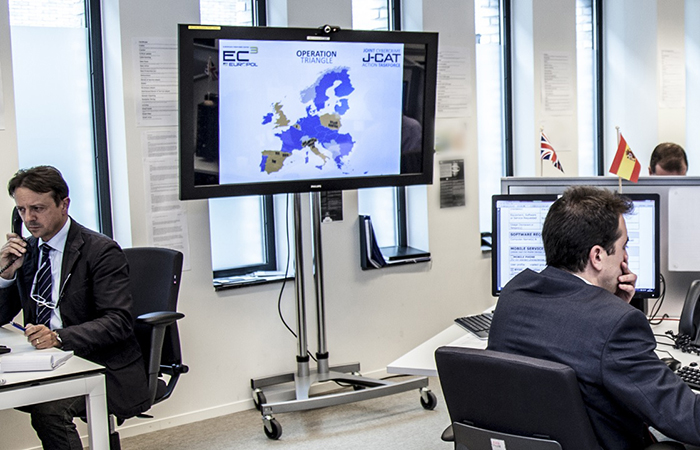
49 Corporate Email Phishers arrested in Operation Triangle

The Europen Union's Judicial Cooperation Unit, EUROJUST, along with Europol's European Cybercrime Center (EC3) and the Joint Cybercrime Action Taskforce (J-CAT) have announced one of their most successful cyber actions to date.   The case, known internally as Operation Triangle, involves three lead agencies - Italy's Postal and Telecommunications Police through its office in Perugia, Spain's Investigative Court no. 24 in Barcelona, and Poland.  (EUROJUST Press Release: "Eurojust and Europol in massive joint action against cybercriminals")

(Click for article:J-CAT operations)
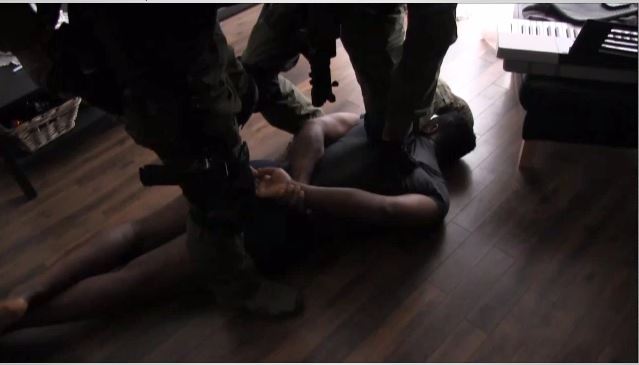
58 search warrants were executed in Spain, Poland, Italy, Belgium, Georgia, and the United Kingdom, resulting in 20 arrests in Italy, 18 arrests in Poland, 10 arrests in Spain, and 1 arrest in Belgium.  Most of those arrested were from Nigeria and Cameroon. 

By gaining control of the email accounts of well-placed individuals in corporations across Europe, the criminals were able to alter requests for payment to send the payments to themselves rather than the business bank accounts that were the intended destinations.  In a short period of time, more than 6 million euros were transferred to accounts controlled by the criminals.

In the United Kingdom, where the J-CAT task force is headquartered, recent government reports indicated that 81% of large businesses (>250 employees) and 60% of small businesses (less than 50 employees) experienced an information security breach in 2013.
(Report available here)

Next week, many European governments will be represented in the Octopus Conference 2015: Cooperation Against Cybercrime. Through the work of Octopus and others, European agencies are gradually coming into agreement on how to address multi-jurisdictional cybercrime.  At last year's Octopus conference, delegates were encouraged to work together through 18 Cybercrime Scenarios.  Fascinating puzzles that we NEED agreement on if we are truly going to stand a chance against the multi-national criminals who steal from our citizens.


UPDATE!  La Stampa article -- 

(Click for LaStampa article, which includes a short video of Italy's Polizia di Stato Cybercrime group)


For the convenience of my mostly English-speaking readers, I offer an English translation via Google Translate below.  This article is available to the Italian reader by clicking the story headline in Italian:

Phishing contro aziende: 62 arresti in Italia e all’estero, smantellata rete internazionale

Phishing Against Companies:  62 arrested in Italy and Abroad, International network dismantled: 
An operation that goes from Perugia to Turin and expands throughout Europe.  Here's how the scammers did it.

Via "LaStampa" journalist Carola Frediani and Google Translate -- 

It all started with a payment of 33 thousand euro. A routine, a transfer made ​​by a company of the Venetian food, which through its Spanish subsidiary had paid a supplier. Or rather, what he thought to be a provider, not suspecting that behind the request for a change of code Iban which paid the money was concealed an organization dedicated to computer fraud to the detriment of businesses and recycling. He had before hacked supplier and now he was impersonating online through email.
So that money, rather than to the real suppliers of the Veneto, end up on a postal account in Perugia made ​​out to a citizen of Cameroon. Which in turn has contacts with a criminal group based in Turin, specializes in money laundering and run by Nigerians, as revealed recently in an investigation of Europol and the Guardia di Finanza Piedmont.

 Operation Phishing 2.0

This episode started then the footage of another Italian international investigation, codenamed Phishing 2.0, which has once again at the center of the fraud against companies, and this morning has resulted in 62 arrest warrants in various countries, including 29 issued by prosecutors in Perugia.
An investigation then born and coordinated in Perugia, bounced on Turin had already been identified where a hub of illicit proceeds, and extended between Italy, Spain and Poland, with the support of Europol and Eurojust, the judicial cooperation unit of 'European Union.

The victims

Fifty (7 of which are Italian) companies all over the world were victims of digital fraud, 800 scam transfers were identified, 800 thousand euro taken away from businesses and recovered during the investigation, around 5 million euro estimate of the economic damage caused by the group in its business that dates back to 2012. The offenses: unauthorized access to computer systems, impersonation, aggravated fraud, and receiving stolen property.

How did it work

The mechanism of the scam started with a series of computer intrusions in the mailboxes of the companies targeted - characterized by having many foreign relations - through an advanced form of phishing, a technique that consists of sending email fake trying to trick the recipient, and then infect and / or [carpirgli] information. After obtaining the credentials of the emails of employees of a company, cybercriminals were monitoring the exchange of mail identifying commercial relationships, creditors and debtors; then they sent an email to the debtor to turn communicating a change of Iban [online payment destination address?]. Iban that actually corresponded to an account managed by a member of the organization.
 
To manage the assets of phishing was a network of Nigerians, Cameroonians and Senegalese, some of whom were residents in Italy. Once at the bank, also on many giro Italian, the money were taken quickly and redistributed abroad through various systems, including money transfer. "There was a division of roles," he told La Stampa Anna Lisa Lillini, assistant chief of the police post Umbrian added. "Who identified the victims took 50 percent of the amount; who was offering the bill received 30%; and the mediator that the hacker got in touch and took the 20%. " The amount stolen went from 800 up to 250 thousand euro. "In one case we have intercepted one wire of 300 thousand euro from America to  Turin," explains Lillini.

Between Umbria and Piedmont

Turin made ​​from recycling center, and here the investigation Perugia converges with what we previously reported from Turin, [LaStampa's article "Nigerian Drops: Women and Companies Cheated Online"] . In that system, the money stolen from the companies were sent to other parties, with dozens of credit transfers and of people involved, up to a stage where cash was taken piecemeal. A branched system, which were scattered in many streams ([ribattezzatto] precisely Nigerian Drops by investigators) and that has been traced through some specific analysis tools used by Europol. "In one case, one person has taken 150 thousand euro in eight hours making dozens of drops in different branches," says La Stampa Captain David Giangiorgi of the Financial Police of Turin. "The fraud was perpetrated by persons residing in Nigeria. The money was sent in the form of assets purchased with the proceeds of the scam and then shipped to the African country. "

A growing phenomenon

This kind of scams are increasingly common. "Just this week, carrying out a survey of defense on behalf of an Italian company that had lost many thousands of euro through a similar system, we were able to triangulate who had sent the phishing emails, and these seem to come just from Lagos (Nigeria) ", explains Paolo Dal Checco, the Turin studio of computer forensics, Digital Forensics Bureau (Di. Fo. B) that has long followed precisely such cases.
 
The interesting aspect is that the story in question fraudsters had been in touch with the company through Skype, as well as email. And through the program of VoIP (and with some tracking systems of the email), computer forensic experts have identified the IP address of the interlocutors. "By now using increasingly sophisticated techniques," says Dal Checco. "In some cases they go even to call pretending to be a creditor of the company contacted."


UPDATE #2 -- The News from Spain

The Spanish National Police have also released information about this case, in their press release of June 10, 2015.   As with the Italian article above, click the Spanish headline below for the original article.  For the convenience of English-speaking readers, we share a Google-translate-assisted version below:

Operación simultánea en España, Italia, Bélgica y Polonia contra una red de fraude cibernético

 (Images, courtesy of Spanish National Police press office - prensa.policia.es)
Spanish National Police perform on-site mobile forensics during one of their raids


Two suspects detained by Spanish National Police

Simultaneous operation in Spain, Italy, Belgium and Poland against cyber fraud network

National Police
Spain, Italy, Belgium, Poland, 06/10/2015
 
Joint operation of the National Police, NCA and the British Police in Italy and Belgium, coordinated by Europol and Eurojust
 
There are 49 detainees -10 of them in Spain and there have been 28 homes in which 9,000 euros have been seized along with laptops, hard disks, phones, tablets, credit cards and extensive documentation on the activities of the network.
 
Those arrested by means of intrusion techniques and social engineering, were able to control corporate email accounts and to interfere in international financial transactions between different companies and thus were able to modify the target bank accounts and thus appropriating money illegally
 
National Police agents have participated in a simultaneous operation conducted in Spain, Italy, Belgium and Poland against a network of cyber fraud. In this joint operation coordinated by Europol and Eurojust also they participated British NCA agents and police in Italy and Belgium. There are 49 detainees -10 of them in Spain and there have been 28 homes in which 9,000 euros have been seized laptops, hard disks, phones, tablets, credit cards and extensive documentation on the activities of the network. Those arrested by intrusion techniques and social engineering, were made to the control of corporate email accounts to interfere in international financial transactions between different companies. Thus they managed to change the target bank accounts and thus appropriate the money illegally.
 
The international coordination was established effectively through Europol headquarters in The Hague and link to cybercrime agent of the National Police. In this way it has enabled the operation has been developed jointly and simultaneously in all countries where they lived active members of the criminal structure dismantled. It also has received support personnel and Europol mobile office moved to places where it has intervened.
 
Modus operandi
The cyber attack used by this criminal group is called man-in-the-middle, which is to control email accounts, in the case of medium and large European companies. The members of the network were reviewing the messages sent and received from corporate accounts to detect requests for payment. Then modified the messages for payments were transferred to bank accounts controlled by the criminal group.
 
These payments were charged by the criminal organization immediately through different means. The investigation, originating mainly from Nigeria, Cameroon and Spain, then transferred the money out of the European Union through a sophisticated network of money laundering transactions.
 
The investigation culminated with the arrest of 49 people in Spain (10), Italy, Belgium and Poland. In addition there have been 28 homes, 8 in Spain, 2 in the UK and 18 in Italy, where agents have seized 9,000 euros in cash (5000 in Italy and 4000 in Spain), laptops, hard drives, mobile tablets, credit cards and extensive documentation on the activities of the network.
 
The operation was carried out by officers of the Unit for Technological Research and the Police Headquarters of Catalonia of the National Police, the Italian Polizia di Stato, the Polish National Police and the British National Crime Agency.  

UPDATE #3 -- The News From Poland

The Polish National Police have also issued a press release about the arrests made in Poland.  Click the Polish language headline below for the original article.  A Google-translate assisted version follows for the benefit of our English-speaking readers.  (stills from video http://cbsp.policja.pl/dokumenty/zalaczniki/3/3-165386.mp4 )

Police in Poland prepare for a raid.

The Phishing suspect is apprehended


Laptops, passports, cell phones, and cash seized in the raid

Międzynarodowa operacja Europolu i Eurojustu - w sumie zatrzymano 49 cyberprzestępców

(International Operation of Europol and Eurojust - a Total of 49 Criminals Arrested)

Officers Coordination Team Central Bureau of Investigation Police and Border Guard as well as police officers Municipal Police Headquarters in Krakow and the Department for Combating Cybercrime Regional Police Headquarters in Krakow, acting under the supervision of Appellate Prosecutor's Office in Krakow together with the police and law enforcement authorities from Italy and Spain, with collaboration with investigators from Belgium, Georgia and the UK and support of Europol and Eurojust, figured out an international organized criminal group, engaged in money laundering, originating, inter alia from phishing attacks carried out against citizens of European countries. On the Polish territory had been detained this matter for a total of 18 people.
 
On June 9th and 10th,  Europol and Eurojust conducted an international action against cyber criminals. A total of 49 suspects have been detained. The activities were also conducted in Poland.
Yesterday, in the province of Malopolska police activity was carried out in this case, one of the most important leading to the arrest of five people, including the man who organized criminal dealings on Polish territory. The Central Investigation Bureau Police seized more than 160 thousand from phishing.
 
In total, the Polish were detained in that case 18 people. According to estimates investigators, members of criminal group could "launder" a total of over 7.7 million (this amount coming only from the crimes committed in our country).
 
Detained charges of fraud, money laundering and participation in an organized criminal group.
On account of the suspect threatened penalties and fines secured property value of 1.8 million.
 
Results of "Operation Triangle" are the result of large-scale investigations carried out in Italy, Spain and Poland (Central Bureau of Investigation Police Department with the participation of cybercrime Police Headquarters in Krakow under the supervision of Appellate Prosecutor's Office in Krakow). The aim was to break organized crime groups engaged in phishing on the Internet. These types of crimes are carried out by specialized criminals who use the Internet to commit fraud. In addition criminals from exploiting cyberspace to "laundering" of money, proceeds of crime. In this way, embezzlement made substantial amounts of money from victims throughout Europe.
 
In parallel, the investigation showed the existence of international fraud on a massive scale, extortion million in short time. The suspects, mainly from Nigeria and Cameroon, upload illegal profits outside the European Union through a complex network of transactions related to money laundering.
In preparation for the run yesterday and today operations, Eurojust coordinated the gathering of information from various law enforcement agencies, as well as organized several coordination meetings with representatives of national authorities from Italy, Spain, Polish, Belgium and Great Britain. With all these joint efforts, coordination center was established who carried out the operation with the support Team. Analysis Affairs Eurojust, the European Centre for the fight against Cybercrime Europol (EC3) and the Joint Task d. Cybercrime (JCAT) - a new European institution created to assist investigations to combat cybercrime.
 
Joint action brought excellent results, while she realized that joining forces selected EU agencies and national authorities can successfully contribute to the fight against one of the most difficult to detect forms of contemporary crime.
 
Teresa-Angela Camelio, National Assistant Representative of Italy to Eurojust, commented: "Eurojust played a key role in promoting the agendas of EU efforts in combating this type of crime, which requires knowledge, cooperation and coordination between all involved national and international actors. The results of the two-day operation are a clear signal to criminals that they will be prosecuted in every jurisdiction. "
 
Phishing on the Internet: This type of cybercrime, carried out by organized criminal groups, depends on gaining access to passwords and names (nicknames) of users for illegal activities. Criminals replace respective owners information through "phishing" their data and thereby gain access to their accounts, which means access to the money the victims and their customers. Credentials obtained in this way by organized criminal groups hurts many Internet clients, while generating billions of euros of profits for organized crime groups.

Monday, March 30, 2015

Tech Support "pop-ups"

There is a new trap on the Internet that seems to be growing in popularity in the form of a Tech Support pop-up Window.  The first of these I saw was last Tuesday, March 24, 2015.

Norton Scam


While reviewing some pharmaceutical spam web pages, we were suddenly forwarded to the page:

alert.norton.com.pctechhelpforyou.com/index-15mac.html

Immediately after this page rendering, a pop-up window is repeatedly displayed insisting that we need to call the telephone number 1-888-884-7058, ringing a bell each time the window is displayed.  The pop-up is so insistent that it is very difficult to get past the pop-up to close the browser.

Despite the fact that this pop-up is warning me about my APPLE COMPUTER, the original trigger that we encountered was in a Windows 7 Virtual Machine.

Looking at the source code for the page we see that we are dealing with JavaScript that has several tricks, including "right-click disable" and an annoying command "window.onbeforeunload = PopIt".  Actions such as "document.onmouseup" and "document.captureEvents(event.MOUSEDOWN)" help to keep control of the window, making it nearly impossible to close the browser, which also sets itself to appear in the Center of the screen, obscuring other opportunities to deal with the warning.

iPad / Mac Pop-ups


This weekend, I found myself looking at a very similar variant, this time on an iPad, where it was even more difficult to get rid of the pop-up!

Because of the lack of mouse or keyboard on the iPad, this version of the browser pop-up was especially hard to deal with.  The pop-up prevented me from being able to exit Safari!  In the end, it was necessary to power off the iPad, power back on, and then use the "Settings" tab to clear my history and settings.  By default an iPad Safari browser returns you to the most recently visited page, which unfortunately was this pop-up!

As I explored this version, I found that the current domain was hosted on the IP address 198.143.166.36.   This same IP address was also hosting a great number of other suspicious domain names,which began to show up on March 9, 2015, according to the Passive DNS service from Internet Identity.  Checking several of these domains on the Apple forums indicates that victims are charged between $150 and $399 to clean-up an imaginary malware attack.

  • mac-issue-online.com -- https://discussions.apple.com/thread/6684596 (800 680 4131)
  • apple-alert-online.com -- https://discussions.apple.com/thread/6850245
  • safarisecurityissue.com -- https://discussions.apple.com/thread/6516787
  • mac-security-alerts.com -- https://discussions.apple.com/thread/6897787
  • online-window-security.com -- (Windows - see below)
  • window-system-error.com -- suspended (why only this one??)
  • mac-pc-alerts.com -
  • safarisystemalert.com
  • online-system-alerts.com
  • safarialerts.com
  • window-security-issues.com
  • instantcomputerfix.com -- https://discussions.apple.com/thread/6669786
  • techcarelive.com -- https://discussions.apple.com/thread/6527487
  • safarisystemissue.com
  • online-warning-support.com
  • quickbo0ks.com
  • iexpertstech.com
  • ixperts.net
  • joinremote.me
  • i-xperts.us
 The last several of the links on that page appear to belong to a company that does support for Intuit Quickbooks, however "JoinRemote.me" is a remote control tool.  When the telephone number is called, the tech support person walks the customer through entering a tech support code by visiting "JoinRemote.me":
When that is done, the customer service technician is provided remote control access to the computer to "clean it up."

A friend from MalwareBytes has documented similar scammy behavior where a tax-season Intuit helper website ends up charging for a malware removal.  See Jerome's blog here:  https://blog.malwarebytes.org/fraud-scam/2014/03/the-tax-season-tech-support-scam/


By reviewing the Apple Discussion boards, we also saw evidence that several other people were struggling with these pop-up messages:


 Continuing to explore through the Apple discussion forums, we found evidence that this was also discussed back on September 2, 2014 in this post by Carlton Chin:

The September file had a different domain name, and a different telephone number, but could it be shown to be the same scammers?  Was applesecurityalert.com on 1-866-782-9808 related to safarisystemissue.com on 1-800-632-9078?

Back to Passive DNS to try to find out.

According to the Internet Identity Passive DNS system, AppleSecurityAlert.com was hosted on the IP address 50.87.153.101 beginning on August 8, 2014.

That IP address ALSO hosted i-xperts.us, ixperts.net, joinremote.me, and quickbo0ks.com, all of which were also found on both the August/September IP (50.87.153.101) and the March 2015 IP (198.143.166.36).

Several of the attack sites that share these IP addresses are Microsoft imitators rather than Apple.  One example is "online-window-security.com" pictured below:

Imitating Microsoft Security Essentials

Bottom line - anyone seeing one of these pop-ups suggesting that a telephone number be called for support is DEFINITELY dealing with a scammer and should terminate the session immediately.


Tuesday, February 24, 2015

Connected World Conference 2015

This week I've been attending the Connected World Conference 2015, hosted here in Birmingham,  Alabama.  Connected World's editor-in-chief, Peggy Smedley, hosts a weekly radio program that focuses on the Internet of Things (IoT) which their industry has called M2M for many years before the IoT tag came along.   Peggy's website has a great tutorial on the Machine To Machine networking technologies and the many ways in which they communicate, but I think nothing really brought the point home to me until I attended the Connected World Awards dinner last night.

If you are thinking about Cyber Security and the Internet of Things, here are quite a few interesting applications I learned about in the dinner last night.  The full range of Connected World Award winners are listed here, but these were a few that really caught my attention.

AT&T Drive Studio - The AT&T Drive Studio in Atlanta, Georgia - The AT&T Drive Studio™ is the first connected car innovation center in the U.S. to be opened by a wireless carrier. And AT&T is inviting the world's most innovative companies and developers to come create the future of connected cars.

ApartmentGuardian, powered by RacoWireless, won the Gold award in the PERS category.  Property managers can use the technology in many ways, from protecting their Lone Workers with a personal safety button (reminiscent of the "I've Fallen and I Can't Get Up!" button that you might buy for your grandmother) to a system for identifying guests to the property in a combined ID card and biometrics solution for visitors to the property, and innovative Security Panels.  The use of low-power radio technology as a backup to "wall power" for keeping your building security and alarm systems online and active during power failures.

Two companies won awards in the Lighting/Manufacturing category.  In both situations the recipients, Atlantic States and Clow Water Systems, were able to achieve amazing savings in both energy and true financial savings by putting in intelligent lighting systems.  Synapse Wireless allows the light fixtures in both organizations to be controlled remotely and through connecting all of the lights in a "Mesh" system - a cloud of lighting services that are in constant communications with one another.

SNAP LightSense from Synapse Wireless

Mesh Systems was the IoT-enabler for BUNN who received an award in the Remote Equipment Management category.   You have heard of the IoT refrigerator, but BUNN has created the IoT Coffee pot!

One of the most interesting M2M applications was SOLARKIOSK, which is using Gemalto's Cinterion modules to deliver remote connectivity and a web-interface for monitoring power production to a mobile unit about the size of a food truck that can be deployed in remote areas, including extremely rural Africa, to provide power and cellular connectivity to areas that lack reliable power.  The first such unit was featured in this story "First SolarKiosk opened in Ethiopia."  The creator, Lars KrĂĽckeberg, was featured in a TED talk about the technology as well.

The IoT enables some interesting Fleet Management capabilities as well.  CalAmp and the City of Dayton received an award for their system for monitoring and protecting their fleet of 210 snow removal vehicles.  The system, called GovOutlook, turns itself on when a key is inserted into a vehicle, and requires a City of Dayton employee id badge to be scanned to prevent lockdown and alarming.  The system also provides safety for the drivers, who are out on the roads, often in the middle of the night, plowing the 1800 lane miles of snow-covered roads in the city of Dayton.


The focus of our Connected World Conference this year has been on Cyber Security ... speakers including myself and John Grimes from UAB, JD Sherry from Trend Micro, Seth Danberry from Grid32, Jonathan Ratner from Sixgill, Brian Zaugg from Authentic8 and others joined to share our thoughts on Cyber Security to those who have come from the Internet of Things / Machine 2 Machine world.  I was glad I participated and learned much more about the IoT world!

Thanks, Peggy!

To learn more about the IoT, please do check out Connected World Magazine and check in with the Peggy Smedley Radio show.


Friday, February 06, 2015

DIA Cyber Warrior delivers first Worldwide Threat Assessment

Vincent R. Stewart, Lieutenant General, U.S. Marine Corps was promoted into the position of Director of the Defense Intelligence Agency. While our friend and colleague Lt. General Ronald Burgess (ret.), now at Auburn University here in Alabama, certainly understood and respected the importance of the cyber domain, General Stewart represents the first time we have a true cyber warrior at the helm of the DIA.  Immediately prior to his appointment as Director of the DIA, General Stewart served as the commander of the Marine Force Cyber Command (described at the end of this blog post.)  General Stewart was director of Marine Intelligence from 2009 to 2013, rising through the ranks in a long and distinguished career that began with humble beginnings in Jamaica and includes many decorations for valor and leadership.


Worldwide Threat Assessment - Cyber

On February 3, 2015, Lt. General Stewart delivered his first Worldwide Threat Assessment to the Senate Armed Services Committee. (Transcript here). So what did our new DIA Cyber Warrior leader have to say about Cyber threats?

The briefing began, appropriately, with a status of Iraq and Afghanistan, focusing on terrorist threats from ISIL, al-Qa'ida, and the Taliban. After that he touched on certain other "violent extremist organizations" and concluded with a region-by-region and global threat summary.

In his discussion of ISIL, al-Qa'ida, and the Taliban, no technology or internet discussion was featured. Expanding beyond Iraq, AQAP (Al-Qa'ida in the Arabian Peninsula) was said to be focused on commercial aviation targeted with innovative explosions. AQIM (Al-Qa'ida in Lands of the Islamic Mahgreb) is mostly focused on kidnapping and attacks against allies. The Al-Nusrah Front and the Khorasan group were said to be focused on providing personnel and training in Syria, but with an interest in targeting western interests. IRGC-QF (Islamic Revolutionary Guard Corps-Quds Force) and Lebanese Hizballah were described a "instruments of Iran's foreign policy and its ability to project power in Iraq, Syria, and beyond." Boko Haram was described as having the potential to expand beyond Nigeria to become a "significan regional crisis."

Cyber Operations

The first mention of cyber comes with regard to Russia, mentioning that Russian actions against Kyiv included "the use of propaganda and information operations, cyberspace operations, covert agents, ..."While the other regional assessments did not include cyber individually, cyber was brought up in the concluding portion of the remarks in the section labeled "Global Threats."

General Stewart's points on the lack of consensus about the status of cyber attacks was especially telling. The "big bullets" from the cyber portion of the talk seem to be:

  • aggressive attacks against DoD and allied defense networks
  • increased cyber-espionage against DoD and Defense Contractor networks
  • concerns about supply chain vulnerabilities
  • increased use of cyber operations in regional conflicts
  • a lack of international "norms of behavior" in cyberspace
  • freedom of action, especially by Iran and North Korea, to conduct peacetime cyber offensive attacks on western interests without fear of reprisal
  • the use of the Internet by non-state actors for Communication, Propaganda, Fundraising, and Recruitment
Below I quote the General's remarks on cyber in full:
The global cyber threat environment presents numerous persistent challenges to the security and integrity of DoD networks and information. Threat actors now demonstrate an increased ability and willingness to conduct aggressive cyberspace operations -- including both service disruptions and espionage -- against U.S. and allied defense information networks. Similarly, we note with increasing concern recent destructive cyber actions against U.S. private-sector networks demonstrating capabilities that could hold U.S. government and defense networks at risk. For 2015, we expect espionage against U.S government defense and defense contractor networks to continue largely unabated, while destructive network attack capabilities continue to develop and proliferate worldwide. We are also concerned about the threat to the integrity of the U.S. defense procurement networks posed by supply chain vulnerabilities from counterfeit and sub-quality components.
Threat actors increasingly are willing to incorporate cyber options into regional and global power projection capabilities. The absence of universally accepted and enforceable norms of behavior in cyberspace contributes to this situation. In response, states worldwide are forming "cyber command" organizations and developing national capabilities. Similarly, cyberspace operations are playing increasingly important roles in regional conflicts -- for example, in eastern Ukraine -- where online network disruptions, espionage, disinformation and propaganda activities are now integral to the conflict.
Iran and North Korea now consider disruptive and destructive cyberspace operations a valid instrument of statecraft, including during what the U.S. considers peacetime. These states likely view cyberspace operations as an effective means of imposing costs on their adversaries while limiting the likelihood of damaging reprisals.
Non-state actors often express the desire to conduct malicious cyber attacks, but likely lack the capability to conduct high-level cyber operations. However, non-state actors, such as Hizballah, AQAP, and ISIL will continue during the next year to effectively use the Internet for communication, propaganda, fundraising and recruitment.


MARFORCYBER background

In January, General Stewart passed control of the U.S. Marine Corps Forces Cyber Command (MARFORCYBER)to Major General Daniel J. O'Donohue.


(a somewhat dated biography of General O'Donohue is available from the Armed Services Committee)

The command, established in October 2009, was complemented by the Navy's U.S. Tenth Fleet Cyber Command. According to the Marine Corps' "Concepts and Programs" document, the mission of MARFORCYBER is to "plan, coordinate, integrate, synchronize, and direct full spectrum Marine Corps cyberspace operations. This includes Department of Defense (DoD) Global Information Grid (GIG) operations, defensive cyber operations, and when directed, planning and executing offensive cyberspace operations. These operations support the Marine Air Ground Task Force (MAGTF), joint, and combined cyberspace requirements that enable freedom of action across all warfighting domains and deny the same to adversarial forces."

MARFORCYBER has two sub-units, Marine Corps Network Operations and Security Center (MCNOSC), which defends the Marine's own network, and Company L, Marine Cryptologic Support Battalion (MCSB), which plans and executes offensive cyberspace operations.
(www.marines.mil/Portals/59/Publications/U.S. Marine Corps Concepts and Programs 2013_1.pdf, PDF page 42)


Tuesday, January 06, 2015

Universities Targeted with "Library Account" phish

Many universities across the country have been targeted with phishing emails that warn their students that their "Library Account" is going to expire. As with so many cybercrime issues, these crimes could be addressed much differently if the Powers That Be were aware that these were not individual cases, but an on-going campaign across victims across the country!

Towards that end, I've collected full text examples of many of these phish, with links to the University web pages where there students have been warned. Hopefully we can start warning people of national on-going campaigns like this BEFORE they are victimized!

While I was reviewing University Phish for this project, I was especially impressed with the phishing details shared at University of Michigan (Go Blue!) and University of Pennsvylvania. Both are great examples of giving students enough details to understand the scope of the risk at hand.

January 2014 Library Account phish


January 9, 2014 - George Washington University
Subject: Library Account
Dear User,

Your library account has expired, therefore you must reactivate it immediately or it will be closed automatically. If you intend to use this service in the future, you must take action at once! To reactivate your account, simply visit the following page and login with your university account. After logging in, your account is reactivated and it will redirect you to your Library Account.

February Library Account phish


February 21, 2014 - Flinders University
Have you received an email asking you to “validate” your Library Account? This email is attempting to steal Flinders user credentials and is not legitimate.

Don’t follow the links in the email, just delete it. The library will never ask you to login to verify your details or activate your account.

May Library Account phish


May 23, 2014 - Lehigh University

June Library Account phish


June 26, 2014 - University of Minnesota
From: Library
Date: Thu, Jun 26, 2014 at 8:47 AM
Subject: Library Account
To:
Dear User,
Your library account has expired, therefore you must reactivate it immediately or it will be closed automatically. If you intend to use this service in the future, you must take action at once!

To reactivate your account, simply visit the following page and login wilth your library account.

Login Page:
xxxxxxxxxxxxxxxxxx
Sincerely,
University of Minnesota Libraries
499 Wilson Library
309 19th Avenue South
Minneapolis, Minnesota 55455
(612) 624-3321 (voice)
(612) 626-9353 (fax)

September Library Account phish


September 10, 2014 - University of Pennsylvania
From: Jonathan Heller < jheller@pobox.supenn.edu > 
Subject: Library Account Access 
Date: Wed, Sep 10, 2014 2:11 PM 

Dear User, 
Your access to your library account is expiring soon and it won't be accessible for you. You must reactivate your account in order to continue to have access to this service. For this purpose, click the web address below or copy and paste it into your web browser. After logging in, your access is reactivated and you will be redirected to your library profile.

(LINK REMOVED)

If you are not able to login, please contact Library Services Manager at jheller@pobox.upenn.edu .


Sincerely, 
Jonathan Heller 
Library Services Manager 
Access & Delivery Services 
Penn Libraries 
University of Pennsylvania 
(215) 898-8956 
jheller@pobox.upenn.edu 

September 17, 2014 - University of North Carolina Health Sciences Library
Alert: Phishing Emails Impersonate UNC Library

Some members of the UNC community have received false emails that appear to be from the Library.

These emails state that “access to your library account is expiring soon and it won’t be accessible for you.” The email directs the recipient to a link that appears to be from the Library.

October Library Account Phish


October 8, 2014 - UC Denver's Auraria Library
October 9, 2014 - University of Colorado Health Sciences Library
The University has been recently subjected to a phishing attack. The subject line of these new phishing messages is “Library Account Access”. These emails are designed to appear as if they are coming from the library concerning a library account activation. The phishing emails also contain links to malicious web sites that ask for your University information (Name and student/employee ID).


October 10, 2014 - Miami University of Ohio
    From: XXX XXX [mailto:xxxxxxxx@miamioh.edu]
    Sent: Friday, October 10, 2014 12:45 PM
    To: xxxxxxxx@miamioh.edu
    Subject: Library Account Access

    Dear User,

Your access to your library account is expiring soon and it won’t be accessible for you. You must reactivate your account in order to continue to have access to this service. For this purpose, click the web address below or copy and paste it into your web browser. After logging in, your access is reactivated and you will be redirected to your library profile.

(LINK)

If you are not able to login, please contact Library Services Manager at xxxxxxxx@miamioh.edu.


    Sincerely,
    
    Alison Withers
    Library Services Manager
    Access and Delivery Services
    University Library
    Miami University
    513-529-2938
 

October 30, 2014 - Virginia Commonwealth University
To:
From: Access Services Manager 
Date: 10/30/2014 11:54AM
Subject: Library Account Access

Dear User,
Your access to your library account is expiring soon and it won’t be accessible for you. You must reactivate your account in order to continue to have access to this service. For this purpose, click the web address below or copy and paste it into your web browser. After logging in, your access is reactivated and you will be redirected to your library account.

(Link redacted, actual link goes to login.vcu.edu.cavc.tk)

If you are not able to login, please contact Library Services Manager at kbonis@vcu.edu.


Sincerely,

Kerry Bonis
Library Services Manager
Access & Delivery Services
Main Library
Virginia Commonwealth University
(804) 827-3968

November Library Account phish


November 13, 2014 - Illinois Institute of Technology
IIT faculty, staff and students may have received an email to “All Members of the University of Illinois” notifying you about a new library system that requires you to activate a new library account. Do not respond to this email. It is a phishing attempt to collect IIT campus-wide ID numbers (CWIDs).

Library users affiliated with Illinois Tech gain access to subscription databases when off-campus by entering their CWID. Releasing that information to a third-party may result in access to our databases being limited or cut off. You can always safely access the library website by using the IIT Portal links, or going directly to the library website. If you believe your CWID has been compromised, please contact the OTS support desk.


November 17, 2014 - Southern Methodist University
Sample Phishing Email

Subject: Library Account Access
Sender: Jane Sippell 

Dear User,
Your access to your library account is expiring soon and it won’t be accessible for you. You must reactivate your account in order to continue to have access to this service. For this purpose, click the web address below or copy and paste it into your web browser. After logging in, your access is reactivated and you will be redirected to your library profile.

Note – this link appears in the email:

https://libcat.smu.edu/cgi_bin/ldapauth.cgi_loginType=E25JFHNfCD7…

The actual destination does not point to the SMU library catalog but to a web address at http://libcat.smu.edu.cvre.tk

http://libcat.smu.edu.cvre.tk/cgi_bin/ldapauth.cgi_loginType=E25JFHNfCD7v…

If you are not able to login, please contact Access Services Manager at jsippell@smu.edu.


Sincerely,

Jane Sippell
Access Services Manager
Access & Delivery Services
Central University Libraries
Southern Methodist University
(214) 919-5931
jsippell@smu.edu
November 17, 2014 - University of Arizona
From: library (EMAIL ADDRESS REMOVED)
Subject: Library account
Date: November 17, 2014 at 8:46:39 AM MST
Reply-To: (EMAIL ADDRESS REMOVED)

Dear User,
Your library account has expired, therefore you must reactivate it immediately or it will be closed automatically. If you intend to use this service in the future, you must take action at once!

To reactivate your account, simply visit the following page and login with your library account.

Login Page:

(URL REMOVED)

Sincerely,

The University of Arizona Libraries
(ADDRESS, PHONE NUMBER AND URL REMOVED)


November 18, 2014 - Washington University in St. Louis
Dear User,

Your access to your library account is expiring soon and it won’t be accessible for you. You must reactivate your account in order to continue to have access to this service. For this purpose, click the web address below or copy and paste it into your web browser. After logging in, your access is reactivated and you will be redirected to your library profile.

(LINK)

If you are not able to login, please contact Access Services Manager at *********@wustl.edu.

Sincerely,


November 19, 2014 - Ball State University Library
University Libraries was alerted that some members of the Ball State community received an email message stating their library account was soon to expire. The email said to reactivate the account by clicking on a web address included in the message. This was a phishing scam and the campus Office of Information Security took steps block access to the phony site.

December Library Account Phish


December 1, 2014 - Harvard University
December 1, 2014 - McGill University (Canada)
    From: Library  
    Subject: Library Account
    Sent: Monday, December 01, 2014 8:49 AM
    To: 

    Dear User,
    Your library account has expired, therefore you must reactivate 
    it immediately or it will be closed automatically. If you intend 
    to use this service in the future, you must take action at once!

    To reactivate your account, simply visit the following page 
    and login with your library account.

    Login Page:

    Sincerely,

    McGill Library
    McLennan Library Building
    3459 rue McTavish
    Montreal, Quebec
    H3A 0C9
 
December 1, 2014 - Cornell University
Subject: Library Account
Date: December 1, 2014

Dear User,

Your library account has expired, therefore you must reactivate it immediately or it will be closed automatically. If you intend to use this service in the future, you must take action at once! To reactivate your account, simply visit the following page and login with your library account.

Login Page:
(BAD LINK)

Sincerely,

Cornell University Library, Ithaca, NY 14853 | (607) 255-4144


December 3, 2014 - University of Tennessee Knoxville
Dear User,

Your library account has expired, therefore you must reactivate it immediately or it will be closed automatically. If you intend to use this service in the future, you must take action at once!

To reactivate your account, simply visit the following page and login with your library account.

Login Page:

http://www.lib.utk.edu/reactivation?service

Sincerely,


    University of Tennessee
    University Libraries
    Email: library@utk.edu
    Tel: (865) 974-4351
 

December 15, 2014 - California State University Long Beach
December 18, 19, 20, 2014 - University of Michigan - (Hail to the Victors! Go Blue! WELCOME COACH HARBAUGH! Watched you play in 1985 while I was a Wolverine myself!!!) (oops) (blush)
Date: Thursday, December 18, 2014
Subject: Library Account Access

Dear User,

Your access to your library account is expiring soon and it won’t be accessible for you. You must reactivate your account in order to continue to have access to the library services. For this purpose, click the web address below or copy and paste it into your web browser. After logging in, your access is reactivated and you will be redirected to your library profile.

[LINK REMOVED]

If you are not able to login, please contact [LINK REMOVED] for immediate assistance.

Sincerely,


Access Services Manager
University of Michigan Library
(734) 936-2921
[LINK REMOVED]
Date: Friday, December 19, 2014
Subject: U-M library System Problem
Dear [Your Name],

You are receiving this message because your login and off-campus access may have been compromised.

Your access will be inactive in 3 days. Because of some security problems, we decided to make some changes (Upgrade) and this is due to the implementation of a new version of Central Authentication System(CAS) and Umich WebLogin.
This means while you are off-campus or on-campus you will have no access to library's internal web services.

You can activate it by going again simply login to University of Michigan Library Weblogin System with your U-M LoginID and reactive your access.
Offer that Logout your account and close your browser.

Please note: If you get an Authentication Error ,just try 2 times to login again. Because System will automatically block your IP and Account and you should contact Systems Help Desk to Unlock.

University of Michigan Library
818 Hatcher Graduate Library South
913 S. University Avenue
Ann Arbor, MI 48109-1190
(734) 764-0400
[LINK REMOVED]
Date: Friday, December 19, 2014
Subject: ADMIN

Dear Web-mail Account User,

Your e-mail Account have Exceed the 20 GB e-mail Storage Set-Up by your Service Provider/Admin. You have to contact your Service Provider on Help Desk Support Portal below in less than 48 hours to avoid Suspension of your Web-mail Account if you dont Verify your e-mail account. To keep your Account Safe, Kindly Click the Help Desk Support Blue Portal below:

umich.edu-helpdesk [LINK REMOVED]

SERVICE DESK - IT HELP DESK
©COPYRIGHT 2014 WEB-TEAM. ALL RIGHT RESERVED.

December 23, 2014 - Wake Forest University
Dear User,

Your access to your library account is expiring soon and it won’t be accessible for you. You must reactivate your account in order to continue to have access to the library services. For this purpose, click the web address below or copy and paste it into your web browser. After logging in, your access is reactivated and you will be redirected to your library profile.

(LINK)

If you are not able to login, please contact James Hart at hartja@wfu.edu for immediate assistance.

Sincerely,

James Hart
Access Services
ZSR Library
Wake Forest University
336-758-4967
hartja@wfu.edu

December 23, 2014 - UAB Library