Showing posts with label FBI. Show all posts

Monday, September 19, 2022

The new DOJ Law Enforcement Crypto Reports (TL;DR)

TL;DR? Good news!  I read them for you! 

 On 15SEP2022, the Department of Justice released their report "The Role of Law Enforcement in Detecting, Investigating, and Prosecuting Criminal Activity Related to Digital Assets" (66 pages).  The first of the nine reports ordered by President Biden's Executive Order 14067 "Ensuring Responsible Development of Digital Assets" was also released by the DOJ back on 06JUN2022, "How To Strengthen International Law Enforcement Cooperation for Detecting, Investigating, and Prosecuting Criminal Activity Related to Digital Assets" (58 pages). 


Since then, we have seen the Department of Treasury release three reports:

Treasury also provided to the White House in July a "Framework for International Engagement on Digital Assets" which is described in their press release, but not provided to the public. 

Earlier this month, the Department of Commerce released their report:
 "Responsible Advancement of US Competitiveness in Digital Assets" (19 pages). 

The Office of Science & Technology Policy also released three reports:
In this blog post, we'll focus on the two DOJ reports, which we will address in the reverse order of  their release, as it seems that it is required to define the role of law enforcement in digital assets before discussing the international cooperation one would seek in this area.

The Role of Law Enforcement in Digital Assets


Despite the Executive Order, it is important to note that the Department of Justice did not need the urging of the White House to establish procedures for addressing Cryptocurrency.  The department created the Attorney General's Cyber-Digital Task Force in 2018, which produced their original report, published in October 2020, titled the CryptoCurrency Enforcement Framework (83 pages).  That original report characterized the illicit uses of cryptocurrency into three broad categories of criminality: 
  1. financial transactions associated with the commission of crimes, such as buying and selling drugs or weapons, leasing servers used in the commission of cybercrime, soliciting funds to support terrorist activity, or ransom, blackmail and extortion. 
  2. money laundering and the shielding of legitimate activity from tax, reporting, sanctions, or other legal requirements, including operating unlicensed, unregistered, or non-compliant exchanges. 
  3. crimes, such as theft, directly implicating the cryptocurrency marketplace itself, such as stealing cryptocurrency from exchanges or defrauding unwitting investors. 
The original report listed many case studies involving indictments, seizures, and arrests in the scenarios above, including SamSam ransomware, Welcome to Video and DarkScandals child sexual abuse services, terrorist funding both through direct donation and via sales of fake medical equipment (PPE during COVID), the Bitcoin Maven case (Theresa Tetley), BTC-e, Operation DisrupTOR (Wall Street Market), DeepDotWeb, DreamMarket, the Lazarus group hacks, HeroCoin ATMs, the Helix mixer, and others. 

The new report points out something that I've recently been mentioning as well.  Bitcoin and other block-chain-based crypto currencies are neither the first digital currency, nor the first one that has facilitated a great deal of criminal trade.  The report mentions E-Gold (1996) and Liberty Reserve (2006) as "pre-crypto" examples of digital currencies, but could have as easily mentioned Webmoney (1998) or PerfectMoney (2007). Many of the points of the new report echo of those of the prior, although the cases have been updated, such as  Bitfinex, Helix, and Hydra Market, estimated at one point to perform 80% of all darknet market-place transactions, and Garantex, the Estonia-based Exchange that laundered more than $100 million of the funds associated with darknet markets. The Colonial Pipeline ransomware and the use by indicted GRU agents of bitcoin, the theft of $600 Million by Lazarus Group hackers in March 2022 are all used to update the original report. 

Two significant additions are the section on the Growth of Decentralized Finance (DeFi) and Non-Fungible Tokens (NFTs). In this area, the discussion of "Decentralized Autonomous Organizations" as opposed to a traditional corporate structure, and the insider trading, money laundering, and tax evasion aspects of NFT trading are discussed.  (Examples of Nathaniel Chastain of OpenSea and Ishan Wahi of Coinbase are provided as insider examples.) 

Section II of the report discusses DOJ efforts such as the National Crypto Enforcement Team (NCET) and its predecessors such as the Money Laundering and Asset Recovery Section's Digital Currency Initiative, and the Internation Virtual Currency Initiative. A few interesting statistics from the FBI, including that as of July 2022, the FBI had worked 1,100 separate investigations across 100 investigative program categories that involved a digital assets nexus. Since their first digital assets seizure in 2014, the FBI has seized $427 million in virtual assets (as valued at time of seizure.)  In February 2022, the FBI created the Virtual Assets Unit.  The Department of Justice has also created a Digital Asset Coordinators Network which is composed of designated prosecutors in U.S. Attorney's Offices across the country who work closely with CCIPS, MLARS, and NCET.  The program is based on the successful CHIP Network (Computer Hacking and Intellectual Property) and the National Security Cyber Specialist (NSCS) Network which each designate prosecutors in every field office to be specially trained and equipped to handle the relevant case types for their office. 

Cryptocurrency fraud investigations are listed as well, including the Baller Ape Club NFT rug pull case, the EmpiresX crypto Ponzi case, the Circle Society crypto commodities case, and the Titanium Blockchain Infrastructure Services Initial Coin Offering case. The Bitqyck case and the $2.4 Billion BitConnect Ponzi scheme case serve as an example of an IRS Cyber tax evasion cases, with the latter also being charged civilly by the SEC. 

The DEA's Cyber Support Section is described as performing cryptocurrency analysis related to the use of cryptocurrency to facilite drug trafficking, while the US Marshals Service is the group manages and liquidates seized crypto funds. HSI has been a key player in many crypto cases, with at least 500 currently active investigations, especially via their Financial Crimes Unit, Cyber Crimes Center, and Asset Forfeiture Unit. The US Secret Service is also involved, with 302 cases involving digital assets and at least 535 seizures of digital assets valued at more than $113 Million at time of seizure.  The US Secret Service is also a top trainer of state and local law enforcement via the National Computer Forensics Institute (NCFI) headquartered here in Hoover, Alabama! They also operate a Digital Assets Awareness Hub to educate the public on crypto risks. 

Regulatory Agencies also play their part, with FinCEN working to enforce Bank Secrecy Act (BSA) guidelines and regulations related to Anti-Money Laundering and Countering Financing of Terrorism (AML/CFT) requirements. Treasury manages the OFAC office, which includes sanctioning mixer and state-sponsored crypto hackers. The SEC regulates crypto scams that are structured as "investment contracts, such as BlockFi Lending LLC or the DeFi Money Market. The Commodity Futures Trading Commission (CFTC) regulates the trade of commodities in interstate commerce. They have brought 50+ enforcement actions against organizations such as Coinbase, Payward Ventures (Kraken), Blockratize (Polymarket).  BitMEX is one cryptocurrency derivatives exchange targeted for CFTC enforcement, after $209 Million in darknet market transactions were cashed out via BitMEX, who paid a $100 Million fine, with three co-founders pleading guilty to criminal charges and paying a $10 million fine. 

One last organization of note is IVAN, the Illicit Virtual Asset Notification platform, being built by FinCEN and the FBI's National Cyber Investigative Joint Task Force. The goal of IVAN is to be a public-private information exchange to allow industry to collaborate on timely detection and disruption of the use of virtual assets in furtherance of illicit activity. 

Requests for Legislation 

The Justice report does make several requests for additional legislation, in five categories: 

  1. extend the prohibition against disclosing subpoenas (currently in effect for financial institutions) to VASPs (Virtual Asset Service Providers), strengthen the laws against operating an unlicensed money transmitting business, and extend the statutes of limitations from 5 to 10 years for certain crimes. 
  2. support for initiatives that would aid investigators in gathering evidence
  3. strengthening sentencing guidelines for certain BSA violations
  4. extend BSA record keeping rules to VASPs 
  5. ensuring that law enforcement has resources to conduct and staff sophisticated digital asset-related investigations. 
The details for this legislative proposals are in section IV of the report, LEGISLATIVE AND REGULATORY ACTIONS THAT COULD ENHANCE EFFORTS TO DISRUPT, INVESTIGATE,

International Considerations 

One of the main observations of the report on International Law Enforcement Cooperation is the standard complaint that the Mutual Legal Assistance treaties are too slow, and that faster methods of international law enforcement cooperation, such as the "24-7 Network" often do not have a standard way of sharing requests regarding Virtual Asset Service Providers. (VASPs). 

Next, while the western-friendly nations of the world have largely standardized cybercrime laws under the Budapest Convention on Cybercrime, the way in which the nations of the world define, regulate, and enforce actions against VASPs are varied and inconsistent.  Under the concept of Dual Criminality, where one nation may only ask another to enforce laws which are similar in both countries, much of crypto-crime enforcement lacks such standards. 


While the Cybercrime laws may not have caught up, the International body that deals with Anti-Money Laundering, FATF or the Financial Action Task Force, are clear thought leaders on the Virtual Assets guidelines. (We wrote about FATF in 2019, please see: Money Laundering and Counter-Terrorist Financing: What is FATF? ) Unfortunately, as of July 2021, only 35 participating nations had implemented the FATF suggestions regarding virtual assets and VASPs into their national laws. 

My favorite part of the "Strengthening International Law Enforcement" report is Annex B: "Examples of Successful Cross-Border Collaboration on Digital Asset Investigations." 

Liberty Reserve
BTC-e
Helix 
Silk Road 
Operation Bayonet (AlphaBay and Hansa)
Dream Market
Wall Street Market 
DeepDotWeb
Welcome To Video 
Operation DisrupTOR
Hydra Market 
Twitter hack 
Sodinokibi/REvil Ransomware 
NetWalker Ransomware 
BitConnect 

For each example above, details are shared about which international law enforcement agencies partnered with which US agencies in order to reach the successful resolution.  Inspiring reading! 

Friday, March 25, 2022

Russia's Invasion of Ukraine and CISA/FBI's New Era of Transparency

BLUF: Bottom Line Up Front


I want to start this post with the most important thing right up top:

The CISA.gov/Shields-Up page starts with this statement.  PLEASE take it seriously, and escalate to your top management:

"Russia’s invasion of Ukraine could impact organizations both within and beyond the region, to include malicious cyber activity against the U.S. homeland, including as a response to the unprecedented economic costs imposed on Russia by the U.S. and our allies and partners. Evolving intelligence indicates that the Russian Government is exploring options for potential cyberattacks. Every organization—large and small—must be prepared to respond to disruptive cyber incidents. As the nation’s cyber defense agency, CISA stands ready to help organizations prepare for, respond to, and mitigate the impact of cyberattacks. When cyber incidents are reported quickly, we can use this information to render assistance and as warning to prevent other organizations and entities from falling victim to a similar attack."

Organizations should report anomalous cyber activity and/or cyber incidents 24/7 to report@cisa.gov or (888) 282-0870.


Second "Bottom Line Up Front" BLUF point:  CISA has released TTP's of Russian threat actors known to attack US Critical Infrastructure.  If you work there, skip this blog and go read their report first!
"Alert (AA22-083A):  Tactics, Techniques, and Procedures of Indicted State-Sponsored Russian Cyber Actors Targeting the Energy Sector."

CISA/FBI and the New Era of Transparency

 Anyone who has seen one of my presentations recently knows that I am a huge cheerleader for CISA.gov, the Cybersecurity & Infrastructure Security Agency at DHS, which replaced the National Protection and Programs Directorate (NPPD) that previously led private sector engagement and interaction for DHS.

Previously, I've asked people to make sure someone in their organizations was watching four critical information sharing pages at CISA.  


  • https://www.cisa.gov/uscert/ncas/current-activity
  • https://www.cisa.gov/uscert/ncas/alerts
  • https://www.cisa.gov/uscert/ncas/bulletins
  • https://www.cisa.gov/uscert/ncas/analysis-reports
I had already said publicly many times that they are doing a PHENOMENAL job of sharing information - unprecedented in my 22 years of working with the government on Critical Infrastructure Protection, from Ron Dick and the NIPC (National Infrastructure Protection Center), serving on the national boards of InfraGard and the Energy ISAC, and interacting with FS-ISAC (Financial Services), H-ISAC (Healthcare), and REN-ISAC (Research and Education).  But now CISA (and the FBI) has taken Information Sharing to a whole new level.

The White House on Russian Cyber Threats

It started with the White House.  On March 21st, President Biden stated that there was "evolving intelligence that the Russian Government is exploring options for potential cyberattacks." Based on this new intelligence, the administration gave the order that thing that were not previously shared needed to be shared at an even higher level of detail and specificity, including things that were previously deemed too sensitive to share in an unclassified environment. 

That same day, Press Secretary Jen Psaki brought in Anne Neuberger, the Deputy National Security Advisor over Cyber and Emerging Technologies.  She stated that in the past week, CISA and the FBI had held meetings with 100+ Critical Infrastructure Companies to determine a best course forward in helping to protect critical infrastructure, including encouraging them to participate in the CISA Shields-Up! program. 

  • Mandate the use of multi-factor authentication on your systems to make it harder for attackers to get onto your system;
  • Deploy modern security tools on your computers and devices to continuously look for and mitigate threats;
  • Check with your cybersecurity professionals to make sure that your systems are patched and protected against all known vulnerabilities, and change passwords across your networks so that previously stolen credentials are useless to malicious actors;
  • Back up your data and ensure you have offline backups beyond the reach of malicious actors;
  • Run exercises and drill your emergency plans so that you are prepared to respond quickly to minimize the impact of any attack;
  • Encrypt your data so it cannot be used if it is stolen;
  • Educate your employees to common tactics that attackers will use over email or through websites, and encourage them to report if their computers or phones have shown unusual behavior, such as unusual crashes or operating very slowly; and
  • Engage proactively with your local FBI field office or CISA Regional Office to establish relationships in advance of any cyber incidents. Please encourage your IT and Security leadership to visit the websites of CISA and the FBI where they will find technical information and other useful resources.
After this set of announcements, CISA.gov's director, Jen Easterly, convened a meeting that was attended by more than 13,000 Critical Infrastructure stakeholders from all across the United States, including every sector and every size. A recording of the CISA CALL WITH CRITICAL INFRASTRUCTURE PARTNERS ON POTENTIAL RUSSIAN CYBER ATTACKS AGAINST THE UNITED STATES has been shared on their YouTube page!

During the call, which included FBI Deputy Assistant Director for Cyber, Tonya Ugoretz, and CISA Deputy Executive Assistant Director for Cyber, Matt Hartman,  Director Easterly committed to push to have even more sensitive data released to the public if it would possibly help protect American Critical Infrastructure.  And today, we see a great example of that!

Documentation of Two Historical Hacking Campaigns Against Critical Infrastructure

The FBI and the Department of Justice released the legal side, in the form of an extremely detailed press release about Russian hacking campaigns targeting Critical Infrastructure at hundreds of companies in 135 countries.
https://www.justice.gov/opa/pr/four-russian-government-employees-charged-two-historical-hacking-campaigns-targeting-critical


The Press Release was accompanied by two indictments: 

The first, "USA v. Evgeny Viktorovich Gladkikh," (17-page indictment) details the origins, creation, and distribution of the "TRITON" malware.  This attack framework was described in great depth in December 2017 by Mandiant in their report "Attackers Deploy New ICS Attack Framework 'Triton' and Cause Operational Disruption to Critical Infrastructure." While Mandiant described the malware as "an attack framework built to interact with Triconex Safety Instrumented System controllers," they could only say they believed it was "activity consistent with a nation state preparing for an attack." 

Through the new transparency we are seeing, the full details of the indictment are now unsealed and we learn the attacks were conceived and executed from the Russian Ministry of Defense, Federal Service for Technical and Expert Control, in a lab known as the Applied Development Center, which was in turn part of TsNIIKhM, the State Research Center of the Russian Federation Central Scientific Research Institute of Chemistry and Mechanics.  

The second indictment, "USA v. Pavel Aleksandrovich Akulov, Mikhail Mikhailovich Gavrilov, and Marat Valeryevich Tyukov," (36 page indictment) is targeted at members of the Federal Security Service (FSB)'s "Military Unit 71330" also known as "Center 16." Members of this lab are better known by their flamboyant APT Designations:  Dragonfly, Berzerk Bear, Energetic Bear, and Crouching Yeti.  In particular, this indictment addresses their attacks in 2017 which attempted to target and compromise critical infrastructure and energy companies worldwide, including in the USA generally, and in Kansas in particular (the home office of the indictment.) 

Again, the new transparency shows us that these attacks, also known as Dragonfly, Havex, and Dragonfly 2.0, were supply chain attacks, where various ICS/SCADA system manufacturers had their software manipulated to include malicious backdoors which would be downloaded by unsuspecting customers. Through this campaign, at least 17,000 unique devices in the US and elsewhere were compromised, including ICS/SCADA controllers used by power and energy companies. In 2.0, malware was delivered via Spear-phishing attacks and Watering hole attacks targeting employees of such companies. At least 3,300 systems were compromised using this methodology as well. 

Some of the groups attacked in this way included the Nuclear Regulatory Commission, WolfCreek Nuclear Operation Corporation in Burlington, Kansas, Westar Energy, in Topeka, Kansas, and the Kansas Electric Power Cooperative. 

Again, Havex was known to the security community.  Trend Micro wrote about it in their report "HAVEX Targets Industrial Control Systems" back in July 2014, and in more detail in their white paper "Who's Really Attacking Your ICS Equipment?"  Dragonfly 2.0 was similarly discussed, for example by Symantec, in their report "Dragonfly: Western energy sector targeted by sophisticated attack group" in October 2017.  WIRED magazine also wrote about the group Berzerk Bear in October 2020 in their article "The Russian Hackers Playing Chekov's Gun with US Infrastructure." 

But now, in a coordinated Information Sharing To Protect Our Nation blitz, CISA, working with the FBI and the Department of Energy, have released "Alert (AA22-083A):  Tactics, Techniques, and Procedures of Indicted State-Sponsored Russian Cyber Actors Targeting the Energy Sector."

Thursday, July 23, 2020

Chinese "COVID-19" Hackers indicted after 11 year hacking spree


On July 7, 2020, a Grand Jury in Seattle was presented with evidence about the eleven year campaign of Computer Network Intrusion being conducted by two former classmates who hacked for personal profit and the benefit of the Chinese Ministry of State Security. Li Xiaoyu 李啸宇 and Dong Jiazhi 董家志.  The pair met when they were studying Computer Application Technologies at the University of Electronic Science and Technology ("UEST") in Chengdu, China.  UEST has as its motto:  求实求真 大气大为  -- "To Seek Facts and Truth, To Be Noble and Ambitious."  This pair certainly "sought facts" and were "ambitious," though not in a way that many would consider "Noble."  The University was admitted into Project 985 in 2001, a project that supported 34 top universities encouraging each to become a global leader in their chosen specialty, and incidentally kicking off a new ambitious era of global cyber espionage to help them gain competitive advantage.

Or maybe it was exactly the plan.  In 2007, likely the year that Dong would have started his college experience at UEST, the School of Software boasted that as part of the 11th Five Year Plan, their textbook, 计算机病毒技术 (Computer Virus Technology), received national acclaim.  The following year, they announced the completion of their Information Technology textbook series of 8 books, adding "Network and System Attack Technology" and "Network and System Defense Technology" to the series.  In the United States, "Network and System Attack Technology" ( 网络与系统攻击技术)  is mostly taught in the military and intelligence communities, not in undergrad computer science courses.  In 2017 the course was taught by Li Hongwei (李洪伟), whose slides are online.  In 2019 the instructors were 李洪伟 and 吴立军.
Network and System Attack Technology - Cao Yue and Yu Shengji 
An example slide from a previous version of the course which bother of our hackers would have taken:  (Lecture 2, "Information Retrieval")

The text explains one of the tools from the "experimental" portion of the class, "MS06040Scanner": 

The working principle of MS06040Scanner is to first obtain the operating system type and open ports through port scanning and operating system scanning. If it is a windows2000 system, TCP 139 or TCP 445 port is opened, and the returned data packet matches the definition in the vulnerability library. It means that the host may have MS06040 vulnerabilities, we can use MS06040 exploit programs to carry out remote overflow attacks on it

The second slide demonstrates the "X-Scan" tool which would be used to find vulnerabilities allowing data exfiltration.

The Attacks 

According to the Department of Justice Indictment, Dong was the one who researched victims and means of exploiting them while Li primarily did the hacking. 

美国司法部对34岁的李晓宇(音译)和31岁的董佳芝(音译)提出11项指控称,称他们侵入了数百家公司、政府机构以及持不同政见者和神职人员的电脑系统。

Here's how the indictment describes the "Manner and Means of the Conspiracy" -- 

"The defendants research and identified victims possessing information of interest, including trade secrets, confidential business information, information concerning defense products and programs, and personal identifying information ("PII") of victim employees, customers, and others, using various sources of information including business news websites, consulting firm websites, and a variety of search websites.

The defendants then gained unauthorized access to victims possessing the information sought by the conspiracy.  They stole source code from software companies, information about drugs under development, including chemical designs, from pharmaceutical firms; students' PII from an education company; and weapon designs and testing data from defense contractors.

The defendants usually gained initial access to victim networks using publicly known software vulnerabilities in popular products.  Those vulnerabilities were sometimes newly announced, meaning that many users would not have installed patches to correct the vulnerability. ... They also targeted insecure default configurations in common applications."

The defendants used their initial access to place a "web shell" on the victim network, allowing remote execution of commands on a computer.  The most frequently deployed was the "China Chopper" web shell.  They most frequently did so by hiding the file with the name "p.jsp" in an obscure directory on a public-facing website.  (They also sometimes named their webshell's "tst.jsp", "i.jsp", or "/SQLTrace/i.jsp".) The indictment includes a screenshot of China Chopper which is lifted from the FireEye blog post "Breaking down the China Chopper" ... if you are interested, you should also read the Talos Blog post: "China Chopper still active 9 years later

(FireEye explains China Chopper)


They would then plant software for stealing passwords, identifying computer users with Administrator access, and then studying the network for useful data.  The data was compressed as a .RAR file, but then often renamed as a ".jpg" file and placed in the victim's recycle bin until it could be retrieved.

The Victims 

The indictment makes clear that there were "hundreds" of victims between September of 2009 and early 2020, not only the ones listed in this indictment. To characterize the range of victims, they list types of companies, date ranges, amount of data stolen, and type of data gathered. 

Victim 1: California-based technology and defense firm
Dec 2014-Jan 2015
200GB "Radio, laser, and antennae technology; circuit board and related algorithms designs for advanced antennae; testing mechanisms and results."

Victim 2: Maryland-based technology and manufacturing firm - 64GB 

Victim 3: Hanford Site, Department of Energy, Washington State - information about network and personnel, including lists of authorized users and administrator accounts

Victim 4: Texas: 27GB of space and satellite application data 

Victim 5: Virginia Federal Defense contractor - 140GB of project files, drawings and documents related to Air Force and FBI investigations.  PII on 300+ employees

There were many more victims detailed, including:

 a US Educational Software company with "millions of students and teachers' PII." breached from Nov 2018 to Feb 2019, 

 a California pharmaceutical company - 105GB of data in Feb and March 2019 

 a Massachusetts medical device company - 83 GB of source code just as the victim was engaging in a contract with a Chinese firm to produce some of their components.

Other victims were listed in other places, including a large electronics firm in the Netherlands, a Swedish online gaming company (169GB of files including source code and player usernames and passwords), a Lithuanian gaming company, and other companies in Germany, Belgium, the Netherlands, an Australian defense contractor (320GB of data!), a South Korean shipbuilding company, an Australian solar energy company, a Spanish defense firm, and a UK AI firm focused on cancer research.

The Hackers' MSS Connection

The DOJ indictment mentions the Ministry of State Security 19 times, specifically referring to an unnamed "MSS Officer 1." 

"After stealing data and information from their victims and bringing that data and information back to China, Defendants then sold it for profit, or provided it to the MSS, including MSS Officer 1." 

"Li and Dong did not just hack for themselves. While in some instances they were stealing business and other information for their own profit, in others they were stealing information of obvious interest to the PRC Government's Ministry of STate Security ("MSS"). LI and DONG worked with, were assisted by, and operated with the acquiescence of the MSS, including MSS Officer 1, who was assigned to the Guangdong regional division of the MSS (the Guangdong State Security Department, "GSSD"). 

"When stealing information of interest to the MSS, LI and DONG in most instances obtained that data through computer fraud against corporations and research institutions. For example, from victims including defense contractors in the US and abroad, they stole information regarding: military satellite programs; military wireless networks and communications systems; high powered microwave and laser systems; a counter-chemical weapons system; and ship-to-helicopter integration systems. 

In other instances, the Defendants provide the MSS with personal data, such as the passwords for personal email accounts belonging to individual Chinese dissidents including: 
  • a Hong Kong community organizer
  • the pastor of a Christian church in Xi'an
  • a dissident and former Tiananmen Square protestor
  • emails to and from the office of the Dalai Lama
  • emails belonging to Chinese Christian "house" church pastor in Chengdu (who was later arrested)
  • emails form a US professor and organizer
  • two Canadian residents who advocate for freedom and democracy in Hong Kong
MSS Officer 1 assisted LI and other hackers.  When LI had difficulty compromising the mail server of a Burmese human rights group, MSS Officer 1 provided him with 0day malware for a popular browser which exploited a bug not known to the software vendor or security researchers.

MSS Officer 1 claimed to be a researcher at the "Guangdong Province International Affairs Research Center" but in fact was an intelligence officer working for the GSSD at Number 5, 6th Crossroad, Upper Nonglin Road, Yuexiu Distring, Guangzhou.

Example Tools and Techniques 

In several attacks, the attackers (in 2018) targeted ColdFusion vulnerabilities published in 2018 (CVE-2018-15961) attempting to gain access to CKEditor and the associated FileManager, using a ColdFusion web shell program named "cfm backdoor by ufo."  (This tool was actually used in a cool Canadian Government Training on APT groups, although in their training it was an Iranian hacker group using the tool.) 

In some cases, the hackers were clearly operating for personal profit.  Sometimes sending emails with subjects like "Source Code To Be Leaked!" and demanding a ransom payment to prevent publication of their software.

COVID-19 Targeting

On January 25 and 27, 2020, Li searched for vulnerabilities at a Maryland biotech firm who had publicly announced their role in researching a potential COVID-19 vaccine.

On February 1, 2020, Li searched for vulnerabilities in the network of a California biotech firm that had announced the previous day they were researching antiviral drugs to treat COVID-19. 

On May 12, 2020, Li searched for vulnerabilities in the network of a California diagnostics company publicly known to be developing COVID-19 testing kits. 

On June 13, 2020, Li conducted reconnaisance related to a Virginia defense and cybersecurity contractor, Hong Kong protestors, a UK Messaging app used by HK protestors, a Webmail provider used by HK protestors, a Massachusetts biotech firm, and a California space flight firm.


Thursday, October 03, 2019

FBI Fraud Arrests by Field Office, 2018


Each year, crime data geeks look forward to the publication of the CJIS "Crime in the United States" report.  On September 30th, the FBI was able to share the Uniform Crime Report information for 2018, describing information about Violent Crime, Property Crime, Homicides, and Arrests gathered from most of the law enforcement agencies in the United States.  UCR is old news though.  Many short-comings in the system have led to changes which are adopted in the new NIBRS system, the National Incident-Based Reporting System.  For people like me, who care about cybercrime, hacking, malware, and fraud, this is great news!  Many budget decisions have been made over the years about how to allocate police resources based on UCR data, and NONE OF THE CATEGORIES I CARE ABOUT WERE PART of UCR!   But NIBRS has many of those things, rolled up under the category "fraud."

Fraud Offenses are called "26" offenses and have the following breakdown:
  • 26A = False Pretense / Swindle / Confidence Game 
  • 26B = Credit Card / ATM Fraud 
  • 26C = Impersonation 
  • 26D = Welfare Fraud
  • 26E = Wire Fraud
  • 26F = Identity Theft
  • 26G = Hacking / Computer Invasion
(The NIBRS User Manual has the complete list of codes for other offenses.)

Last year, students in my Criminal Justice 502 - Computer Forensics class at UAB (the University of Alabama at Birmingham) - attempted to study fraud statistics from the 2017 NIBRS data, and sadly, their conclusion was that they were dramatically under-reported, and if used at all, used only in a "rolled-up" capacity.  NIBRS is currently receiving data from 6,600 of 18,000 potential law enforcement agencies.  By 2021, all agencies should be using NIBRS instead of UCR.

With shame, I mention that Alabama is one of the states boycotting NIBRS, calling it an "unfunded mandate" and refusing to participate.  In the 2017 data, only the city of Hoover shared NIBRS-formatted crime statistics with the Department of Justice.  (Hopefully we will see an improvement in this process as Alabama is now one of the states receiving federal funding to improve their NIBRS participation in the form of an NCS-X Initiative Grant.  In October 2018, an additional $49 Million was released to encourage greater participation.   A sampling study was conducted by BJS to determine that if 400 additional agencies were added, it would have a marked improvement of the accuracy and usefulness of NIBRS data, and these agencies and their states are now targeted, for the fourth year in a row, with Federal funding to assist in implementation.  Eleven Alabama Law Enforcement agencies were among the 400 on the "List of NCS-X Sample Agencies as of August 2018" making them eligible to apply for funding.  Only four states have not received any funding to date - AK, AZ, MS, and NM. Sixteen states have fully implemented NIBRS, and four more have >80% participation.)

We are still looking forward to seeing the 2018 NIBRS data, which would normally have been released by now, but did get one early present from CJIS, in the form of FBI NIBRS data from each field office.

https://ucr.fbi.gov/ucr-statistics-their-proper-use

A caution before reading on, despite the FBI's repeated warning to not use crime data to rank jurisdictions, journalists repeatedly put out reports called things like "The Top Worst Cities for Murder" each year after the UCR is released.  In the table below, we have extracted the FBI data for Fraud Arrests for each of their 56 field offices.  This is intended to show how fraud arrests (including all of the categories above) are still a MINOR focus of law enforcement by proportion of arrests, so PLEASE don't use this data to rank.  (More reasons not to rank in the link above, which is labeled "Caution Against Ranking" on the Crime in the United States page.

As part of that caution, consider a couple numbers from the table below.  While the average for all field offices was that 10.9% of all FBI arrest in 2018 were for "Fraud" categories, the Los Angeles Field Office number was more than double that amount, at 27.6%.  Why?  Is it because there is more fraud in LA than most places?  Not really.  Their "Fraud Arrests per 100,000 population" is 1.4, nearly double the national average of 0.8. Los Angeles serves the largest population of any field office -- 19.5 million people -- allowing their office composition to contain specialized squads not found in smaller offices. One such squad includes agents dedicated to working "Business Email Compromise" and they have been doing an amazing job at that task.  Because of the STRATEGIC FOCUS of the Los Angeles office, many criminals are arrested and charged there even when the victims may come from across the United States and the World.

Similarly, the Miami, District of Columbia, and New York offices have significantly higher fraud arrest rates per 100,000 populations than other offices. This also reflects the composition of their offices. New York City FBI arrested 1,466 total people in 2018 -- nearly 500 more than any other office, and triple the number of the arrests in only slightly smaller Dallas, Boston, Atlanta, or Charlotte. As a global super power in the banking world, New York City has one of the largest cybercrime offices in the country, including many New York Police Department personnel who serve as Task Force Officers within the FBI's Cybercrime and Financial Crime Task Forces. In offices like NYC, many cases where a local prosecution may have been brought elsewhere by the police have been elevated to a federal level, taking advantage of the unique concentration of banks AND FEDERAL RESOURCES, to make possible their 268 fraud arrests in a field office serving 13.4 million people. Similar combined state/local/federal task forces raise their arrest rate in other categories, partly as a result of the unique partnerships found in New York as a result of the restructuring of the FBI following the terrorist attacks there on 9/11.
Other office numbers may be skewed by the presence of an extremely gifted or well-funded state or local law enforcement agencies, which may work many cases at the state/local level that in other offices may have become federal cases.  
So again, please don't use these numbers for "head-to-head rankings," but do enjoy seeing what is going on in YOUR FBI office!  We look forward to seeing the full NIBRS data soon, but in the meantime, found the data below a fascinating representation of how fraud is fought by the Federal Bureau of Investigation.
(Full FBI Arrestees by NIBRS Offense Code by FBI Field Office, 2018 available here)
(Crime rate per 100,000 is ((Arrests / Population) x 100,000), for example, in NYC, (268/13,464,042 = 0.000019904 * 100,000 = 1.99 (rounded to 2.0) per 100,000 population.)
Field OfficeFraud ArrestsTotal ArrestsPopulation% Fraud ArrestsFraud arrests per 100k population
Grand Total All Offices2,64524,174330,611,01610.9%0.8
Albany191933,959,1429.84%0.5
Albuquerque113682,095,4282.99%0.5
Anchorage3110737,4382.73%0.4
Atlanta 8663510,519,47513.54%0.8
Baltimore203977,009,8895.04%0.3
Birmingham 161532,885,67910.46%0.6
Boston 7851510,654,32615.15%0.7
Buffalo283182,745,3248.81%1.0
Charlotte 2254810,383,6204.01%0.2
Chicago723999,299,34218.05%0.8
Cincinnati 232575,973,0038.95%0.4
Cleveland 404265,716,4399.39%0.7
Columbia253135,084,1277.99%0.5
Dallas 4255610,937,8927.55%0.4
Denver 554006,273,30113.75%0.9
Detroit 1327629,995,91517.32%1.3
El Paso 132171,280,4005.99%1.0
Honolulu19921,420,49120.661.3
Houston 453488,739,89012.93%0.5
Indianapolis 635416,691,87811.65%0.9
Jackson 192302,986,5308.26%0.6
Jacksonville 421295,292,49132.56%0.8
Kansas City215726,107,8123.67%0.3
Knoxville 164132,634,7463.87%0.6
Las Vegas 132943,034,3924.42%0.4
Little Rock 112093,013,8255.26%0.4
Los Angeles 27097819,503,77827.61%1.4
Louisville 171774,468,4020.96%0.4
Memphis 352924,135,26411.99%0.8
Miami 24110487,101,5800.23%3.4
Milwaukee281805,813,56815.56%0.5
Minneapolis 356207,253,4915.65%0.5
Mobile141962,002,1927.14%0.7
New Haven243153,572,6657.62%0.7
New Orleans 132344,659,9785.56%0.3
New York 268146613,464,04218.28%2.0
Newark555338,055,34210.32%0.7
Norfolk 151081,759,48413.89%0.9
Oklahoma City 202523,943,0797.94%0.5
Omaha102945,085,4130.34%0.2
Philadelphia1067239,948,74514.66%1.1
Phoenix 347737,171,6460.44%0.5
Pittsburgh 405435,517,3257.37%0.7
Portland323034,190,71310.56%0.8
Richmond 101104,153,7059.09%0.2
Sacramento 332988,099,06811.07%0.4
Salt Lake City 536065,977,6188.75%0.9
St. Louis 264222,930,1456.16%0.9
San Antonio 368797,743,6630.41%0.5
San Diego 333843,529,0648.59%0.9
San Francisco713428,425,13520.76%0.8
San Juan1407163,443,5825.59%1.2
Seattle 343597,535,5919.47%0.5
Springfield121573,441,7387.64%0.3
Tampa 308008,905,2543.75%0.3
Washington, Dc766713,306,95111.33%2.3

Saturday, August 04, 2018

Fin7 and the Perfect Phish

For the past twenty years, one of the main pieces of advice our industry gave to people regarding their email was "don't open attachments from people you don't know."  But what if your JOB is opening attachments from people you don't know?

On August 1st, the US Attorney for the Western District of Washington, Annette Hayes, and the FBI Seattle Special Agent in Charge, Jay Tabb, along with main Justice's head of the Computer Crimes and Intellectual Property Section (CCIPS), Deputy Attorney General Downing, gave a fascinating press conference about the FIN7 or Carbanak Group case.  (The link shows the 31 minute press conference on YouTube, where closed captioning is available.)

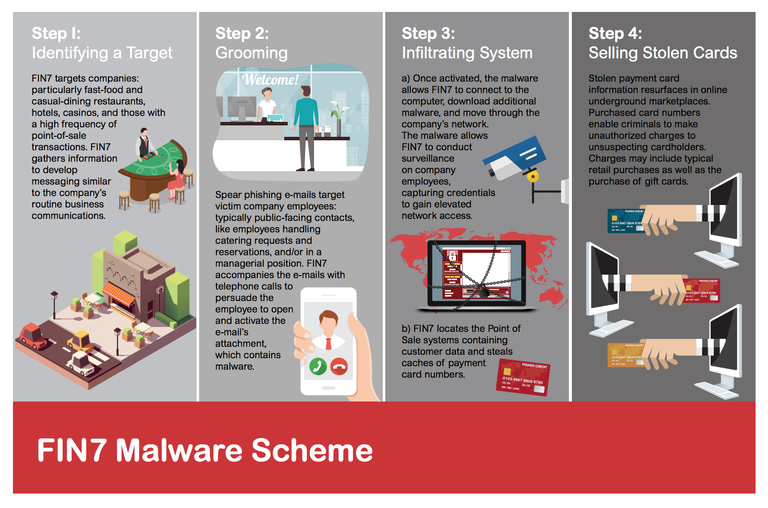
As AG Downing explained it, the FIN7 group would use a combination of emails and telephone calls to encourage people involved in catering or group reservations to open their malicious emails.  Imagine that your job is booking hotel rooms for group travel, or handling large catering deliveries for business meetings from your restaurant.  A new potential customer calls and says "I'd like to book forty hotel rooms for our sports team that is coming to play in a tournament in your town next month.  What email should I send the details to?"  Or "We're having an event at my office and need to order lunch for sixty people.  I know that I could use the online order form, but would you mind if I just sent you an email with the details?"  (I've done the latter myself when ordering FIFTY pizzas from Dominos!)

What sales person is NOT GOING TO OPEN THAT ATTACHMENT?  Right.  Every single one will do so!  Here's the flow of the attack that was shared at the Press Conference:

Depiction of one of the schemes used by cybercrime group FIN7.
(Image from FBI Seattle FBI Office)
Although the schemes I suggested sound complex, some of the emails shared during the press conference were quite simple:

Spear-phishing Email Image from justice.gov

Spear-phishing Email Image from justice.gov


Three criminals were arrested in this scheme, each on their own indictment.  The first two were actually arrested in January 2018, but their arrest and information about their case remained secret as law enforcement continued to hunt for additional members of the FIN7 team.

Also appearing at the press conference were representatives from Visa and Master Card. Marie Russo, SVP of Cards and Franchise at MasterCard.  Marie praised their participation in the NCFTA (the National Cyber Forensics Training Alliance) who offers a service that helps send stolen credit card information to the . Dan Schott, Senior Director of Visa. Both Ms. Russo and Mr. Schott talked about their proactive means of identifying crime trends and coordinated with banks.  Mr. Schott reminded that every Visa card service in the United States offers "Transaction Alerts" that will notify you when your card is used in a transaction. (Unfortunately Schott also quoted the mythical $600 Billion annual cost of cybercrime.)  

Is This Joker's Stash?

We don't know.  Although many of the victim companies have been anonymized, the indictment does reveal that "Victim-1" was the Emerald Queen Hotel and Casino (EQC) in Pierce County, Washington, "Victim-3" was Chipotle Mexican Grill, Victim-5 was the Boeing Employee Credit Union, Victim-6 was Jason's Deli, Victim-8 was Red Robin Gourmet Burgers and Brews, Victim-9 was Sonic Drive-in, and Victim-10 was Taco John's.  Trend Micro has previously published that FIN7 was also involved in breaches at Trump Hotels, Whole Foods, Saks Fifth Avenue and Lord & Taylor.  That latter group of cards is known to have been trafficked on the criminal card market "Joker's Stash", and TrendMicro actually equates the groups.  Their April 2, 2018 press release, "Bank Card Data of Five Million Stolen in Saks and Lord & Taylor Data Breach," begins with the sentence:  "A hacking syndicate known as JokerStash (also identified as Fin7 and Carbanak) announced the sale of five million payment cards on the dark web last March 28.

Trend Micro (click for full article)
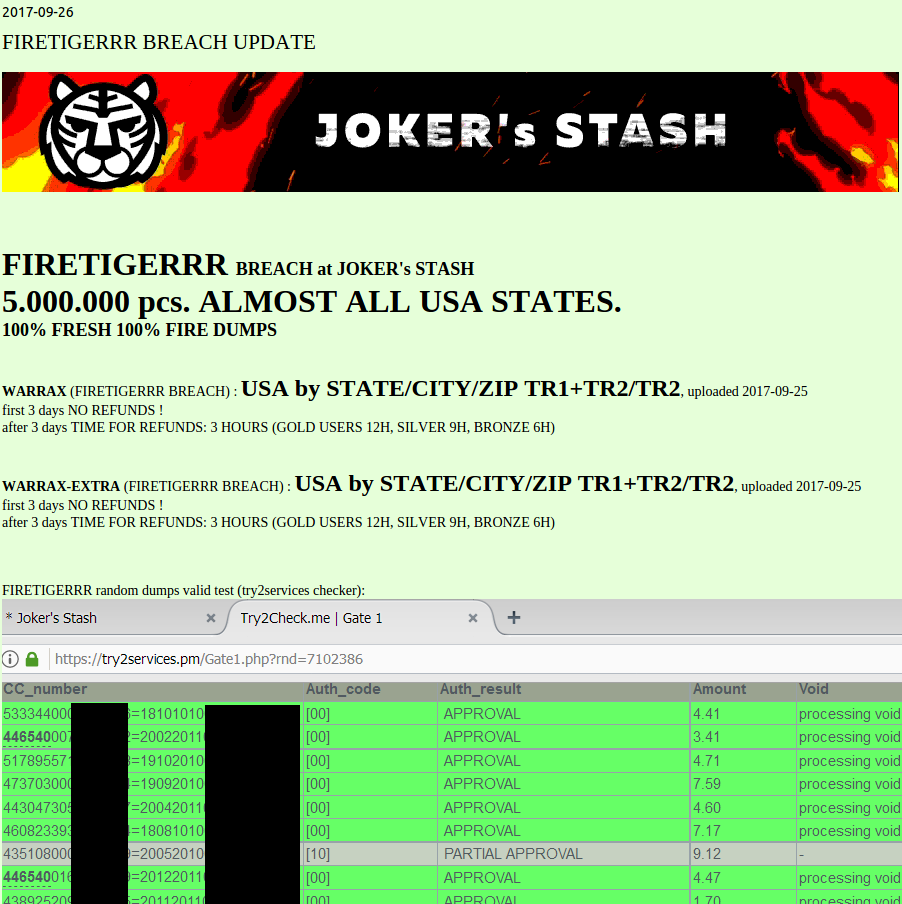
Brian Krebs was one of the journalists who has written extensively about Joker's Stash.  In this image from his blog post "Will the Real Joker's Stash Come Forward", he shares an image of the card "base" "FIRETIGERRR" associated with the Sonic Drive-In databreach, showing a screenshot of the September 26, 2017 announcement on Joker's Stash about the availability of 5 million credit cards:

Image result for joker's stash carbanka
Sonic Drive-In cards being sold on Joker's Stash (image from krebsonsecurity.com)

The indictments do not make the ties between FIN7 and Joker's Stash quite so strongly.  For example, in the Hladyr indictment:

"between approximately March 24, 2017 and April 18, 2017, FIN7 harvested payment data from point-of-sale devices at certain Victim-3 restaurant locations.  FIN7 stole millions of payment card numbers, many of which have been offered for sale through vending sites, including but not limited to, Joker's Stash, thereby attempting to generate millions of dollars of illicit profits.

Three Ukrainian mastermind arrested

Three Ukrainians, Fedor Gladyr (age 33), Andrey Kolpakov (age 30), and Dmytro Fedorov (age 44) were arrested in the current round of actions, although prosecutors made it clear that there will be more arrests in the future.  They also make clear that the top leader of this scheme  has not yet been arrested.

Fedorov is said to have been the first to be arrested, in January 2018, in Poland.  A KyivPost article in February about a 44-year old Ukrainian hacker being detained in Poland on an Interpol warrant is certainly about him ==> "Ukrainian Hacker detained, Faces 30 years in Prison."  

It is unknown how or if this is related to the Spanish Police arrest of "Dennis-K" said at the time to be the leader of the Carbanak Group when he was arrested on March 26, 2018 in Alacante, Spain.  (A YouTube video about that arrest (in Spanish) is available as "Detenido hacker 1000 millones (Denis-K)"  The Times of London called Denis-K a 30-year old Russian-born Ukrainian citizen, living in Spain, whose malware used in cyber attacks in more than 40 countries, and who owned two million dollar houses.  At the time, Europol said this was the end of a 5-year cybercrime spree that had stolen $1.2 Billion. This does NOT seem to be the same person, despite the age match and the "K" last name, as the US case states that Kolpakov was arrested in "late June" in Lepe, Spain.

It is also unknown how or if this is related to the Ukrainian Police's arrest of members of the COBALT game earlier this year.  Europol says that COBALT and CARBANAK are the same group.  It is believed by this author that the current FBI action in Seattle is targeting CUSTOMERS of the malware author group known as Cobalt/Carbanak.  Hopefully this will get sorted out in the near future.  

(Related stories:  


The superseding indictment of Fedor Gladyr
Fedor Gladyr, aka das, aka Fyodor, aka AronaXus, "served as a high-level systems administrator for FIN7 who maintained servers and communications channels used by the organization.  For example, FIN7 members requested Gladyr grant them access to servers used by FIN7 to facilitate the malware scheme.  He also played a management role in the scheme by delegating tasks and by providing instruction to other members of the scheme.  Gladyr used Jabber and HipChat to communicate with his teams.  The team used a JIRA server, usually used to track long software development projects, to communicate about the infiltration of their victims. As a few examples:

07SEP2016 - Gladyr opens an "issue" for Victim-6 for his conspirators to upload files of internal credentials for the company network.
JAN2017 - Dmytro Fedorov opens an "issue" for Victim-7 credentials to be posted.
05APR2017 - Fedorov opens an "issue" for Victim-9 credentials to be posted.

Some of the malicious infiltration of the victim networks came by emailing those malware-laden requests for quotes to companies.  Some examples include:

08AUG2016 - Victim-1, email from just_etravel@yahoo.com
08AUG2016 - Victim-1, email from frankjohnson@revital-travel.com
25AUG2016 - Victim-6, email from revital.travel@yahoo.com 
21&23FEB2017 - Victim-2 two emails
24-25MAR2017 - Victim-3 six emails 
05APR2017 - Victim-9 emails from oliver_palmer@yahoo.com 
11APR2017 - Victim-4 email from oliver_palmer@yahoo.com 
10MAR2017 - Victim-5 email 
27MAR2017 - Victim-8 email from ray.donovan84@yahoo.com 
25MAY2017 - Victim-4 email from Adrian.1987clark@yahoo.com (Subject: "takeout order")
12JUN2017 - Victim-10 email from Adrian.1987clark@yahoo.com (Attachment: order.catering.rtf)

In the case of Victim-1, firewall logs indicate that between August 8,  2016 and August 31, 2016, there were at least 3,639 communications between their organization and "revital-travel.com" addresses hosted on an IP address in Russia.

Not all of the emails were the "customer wanting a quote" type.  On 21FEB2017, pen-testers working for the scheme sent emails purporting to be filings@sec.gov to Victim-2.  The email contained a Microsoft Word attachment and alleged that an important filing was due and that the details for the filing were in the attached document.

Sometimes the stolen information targeted not only the business accounts, but also the personal information of the victims.  One FIN7 member posted a Victim-2 employee's information to their JIRA server, showing screenshots from the employee's computer and including a text file with userids and passwords of their personal email account, LinkedIn account, and personal investment and banking accounts.

Once inside an organization, it was trivial for the FIN7 "pen-testers" to expand.  Some documents posted in JIRA included userids and passwords for more than 1,000 employees, and in the case of Victim 3, point-of-sale malware was planted on many cash register computers nationwide, including 33 locations just in the Western District of Washington.

Victim-8 had an associated JIRA "issue" posted that included screenshots and usernames and passwords for the point-of-sale software management solution used by their restaurant chain.   Hundreds of userids and passwords for employees in at least 798 different locations were also stolen from Victim-8 and posted in the JIRA server.

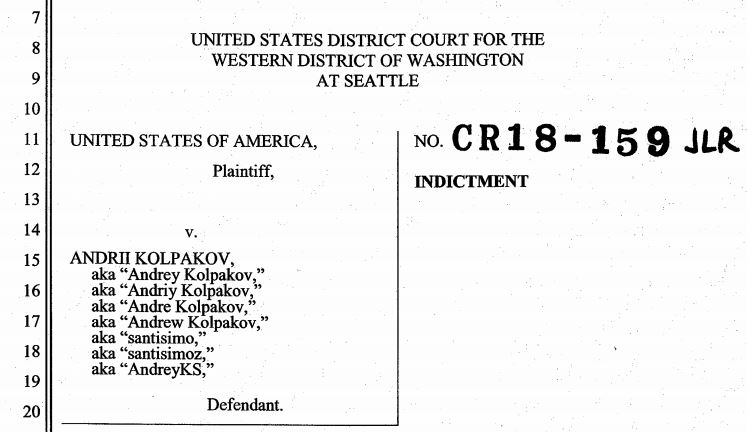
Kolpakov indictment
Andrey Kolpakov, aka santisimo, aka sanisimoz, aka AndreyKS, participated in the scheme from at least September 2015 until June 20, 2018.  In communications to and from Kolpakov, someone in the group referred to Fedir Hladyr and an individual still at large were the "main directors" of the group.  That other individual was also called the "chief manager" of the team.  Kolpakov was introduced to new recruits to the team as their supervisor.  Kolpakov and Dmytro Fedorov had discussions about how to trigger the phishing emails, and which file types would be most effective.  Kolpokov explained to Fedorov on 18SEP2017 that they now had a means to deploy a malware file without requiring the recipient to double-click on it.  Kolpakov's account on the JIRA server was frequently the one that uploaded stolen data in response to the "issues" created by Gladyr.  Many of the uploads mentioned in the Kolpakov indictment are about the particulars of exfiltrated files from password management systems, infrastructure management systems, and in one case an "employee only" web page that the team had altered to gather passwords. Team members regularly communicated on the JIRA server about recommendations for attack vectors to be used against targeted infrastructure.


Dmytro Fedorov Indictment
Dmytro Fedorov's account on the JIRA server was involved in technical exploitation details.  For example, in response to an "issue" created for Victim-7,  Fedorov posted the results of data created by network mapping tools, including IP addresses and network, that helped to explain to the team what addresses should be targeted for further exploitation.

According to his indictment, Fedorov "served as a high-level pen-tester (one tasked with finding vulnerabilities that an attacker may exploit) who managed other pen-testers responsible for breaching the security of victims' computer systems. He specifically created and managed "issues" on the FIN7 JIRA server related to intrusions of multiple companies, including Victim-7 (an automotive retail and repair chain) and Victim-9 (Sonic Drive-Ins).
Fedorov's communications on Jabber seem to indicate that he was controlling the data exfiltration panels associated with malware planted on victim company computers and point-of-sale terminals.  

Combi Security 

Although the current indictments only name ten victim companies, the documentation presented by the US Attorney's office makes it clear that more than 100 companies were attacked by FIN7 hackers working for Combi Security.

FIN7 Attacked at least 3600 locations of 100+ US businesses
If you wanted to have a team of the best hackers available, one option is recruiting people from the dark corners of the Internet, whose names and locations you may not know, and who may have been involved in every sort of trouble.  The other option would be to stand up a cyber security company with offices in Moscow and Haifa, Israel, and advertise for the best trained White Hat hackers to come work for your Penetration Testing (Pen-Testing) team.  FIN7 did the latter.  Using hackers who applied in their real name, showed credentials and certifications, and were in some cases formerly the employees of their respective governments, Combi Security told their hackers that they had been hired to hack various companies, and then those hackers got to work penetrating systems.

Job ads found on a Ukrainian job board indicate that Combi Security had between 21-80 employees.

https://jobs.dou.ua/companies/combi-security/
Google-translation of the ad:

Combi Security is one of the leading international companies in the field of information security. Its headquarters are located in Moscow and Haifa.
We are a team of leading professionals in the field of information security for various organizations working around the world.Our main specialization is a comprehensive audit of projects of any complexity, the supply of software and hardware.
Our main mission is to ensure the security of your activities, minimize the risks of using information technology. Every appeal to us for help is considered with the utmost thoroughness on an individual basis, offering an optimal solution within the framework of the tasks set and the specific needs expressed.
CombiSecurity.com offered their website in Russian, English, and Hebrew:

Their "Contacts" page listed three addresses and telephone numbers:


  • Moscow , Presnenskaya naberezhnaya, 10, block C, tel. +7 (495) 3083827
  • Haifa , 15-A Palyam St. (36 HaAtzmaut St) tel. +9 (724) 6328732
  • Odessa , ul.Uspenskaya, 65 of office 23, 65011 phone. + 38 (048) 7002409
What services did they claim to provide?  Below is their "The Services" page (Google-translated to English), retrieved from Archive.org's Wayback machine entry for CombiSecurity.com:

The services

A qualitatively working security service guarantees an indispensable stability in the operation of your technologies.
Thanks to the active assistance of our technical experts, all the irregularities in the operation of your devices will certainly be detected, analyzed and eliminated. With our professional support, the disrupted monitoring of the security system will turn into a stable process, managed in accordance with established principles and rules.
We provide services:
Penetration test (Pentest)
  • Technological penetration test.
    This penetration test is conducted to identify existing vulnerabilities in the elements of the IT infrastructure, practical demonstration of the possibility of using vulnerabilities (by the example of the most critical ones) and the formation of recommendations for the removal of identified vulnerabilities.
    A penetration test can be conducted for the perimeter of the corporate network (external test) and for internal resources (internal test). Work can be conducted with notification to administrators and users of the system under test, or without it. During internal testing, both the auditor's laptop and the customer's standard workplace can be used.
    In the testing process, both tools and manual analysis methods are used.
  • Socio-technical penetration test.
    This penetration test is conducted using social engineering techniques. The main purpose of the test is to identify the level of awareness of the Customer's personnel about the requirements for information security. In the process of testing, the response of users and personnel responsible for information security to the organizational methods of penetration used by attackers is determined.
    Methods of social engineering are often used by intruders and are directed, as a rule, to end users. As a result of a successful attack, an attacker can gain control over workstations, obtain confidential Customer documents, use the Customer's resources to organize attacks on the systems of other companies, send out spam, etc.
    The organizational aspects of information security are an important part of the protection system and, often, ordinary users are the weakest link. The given service will allow to reveal those organizational aspects of information security, on which the Customer should pay attention first of all.
    The results obtained during the provision of this service can form the basis for the development of the Security Awareness Program, which is maximally focused on the problem areas identified during the testing. This service can also be useful for checking the effectiveness of the current Customer Awareness Program.
  • Integrated penetration test.
    Complex penetration test is closest to the real actions of intruders. Using various technical and socio-engineering methods, auditors try to bypass existing protective mechanisms in order to fulfill the tasks set by the Customer (increasing privileges, gaining access to confidential information, modifying data from DBMS, etc.).
    During testing, the approaches described in the sections "Technological penetration test" and "Sociotechnical penetration test" are used, and the security of the customer's wireless networks is assessed.
The result of the work will be a report containing :
  • Methods of testing.
  • Conclusions for management, containing an overall assessment of the level of security.
  • Description of the identified deficiencies of the ISMS.
  • Description of the testing process with information on all identified vulnerabilities and the results of their operation.
  • Recommendations for the elimination of identified vulnerabilities.
Controlling the level of security
Due to the rapid detection of vulnerabilities and the introduction of changes to the network infrastructure, the results of a one-time verification of the level of security of the corporate network quickly lose their relevance. The need for new inspections arises after several months, and in companies with a dynamically developing IT infrastructure and a large-scale representation on the Internet, this period can be weeks or even days.
The emergence of new vulnerabilities, the change in the structure of the network perimeter, the modification of the settings of servers, network equipment and security equipment, all this requires in-depth analysis on the effect on the resistance to external unauthorized influences.
In this regard, Combi Security Company offers to your attention services aimed at constant monitoring of the state of information security. These include:

  • Monitoring the perimeter security of the corporate network
  • Designing and implementing a security management system
  • Development of corporate security policy
Evaluation of the level of security
Penetration testing works are aimed at overcoming existing protective mechanisms, but not at a deep assessment of the level of security of a specific information system or technology. The penetration approach of the black box analysis often prevents the auditor from detecting some vulnerabilities that are easily detected by other methods, for example, by analyzing firewall settings.
The work to assess the level of security is aimed at a deep assessment of one or another aspect of information security, or a comprehensive analysis of the entire ISMS in general.
Combi Security offers the following services to assess the level of security of various aspects of information security:

  • Integrated audit of information security
  • Assessing the security of Web applications
  • Analysis of application security on mobile platforms
  • Assessing the security of wireless networks
  • The effectiveness of the awareness-raising program in the field of information security
 Raising awareness of users
 Preparing for audit in accordance with international standards, for example ISO 27001
Consultations of experts in the field of it- security.
In addition to these services, sometimes there is a need for solving non-standard tasks. If you did not find something that will help you solve the problem before you, you can contact the experts of Combi Security. Perhaps our specialists have already dealt with similar problems.
Our company offers only those services that we can really carry out with very high quality, services where we can fully utilize the rich practical experience of our specialists.