Showing posts with label USSS. Show all posts

Sunday, September 28, 2025

SMS Pools and what the US Secret Service Really Found Around New York

 Last week the United Nations General Assembly kicked off in New York City.  On the first day, a strange US Secret Service press conference revealed that they had seized 300 SIM Servers with 100,000 SIM cards. Various media outlets jumped on the idea that this was some state-sponsored sleeper cell waiting to destroy telecommunication services around New York.  Like me, you may have immediately wondered why some of the photos showed sophisticated racks of servers on shelves while others showed a hodge podge of devices strewn about the bare floor of an otherwise empty apartment. 

photos extracted from USSS reporting

SIM Pools on Telegram 

Beginning in late 2024, every cell phone in the USA started getting hit hard with annoying messages claiming to be informing us of undelivered packages. In early 2025, this morphed into the famous "Toll Road" phishing messages which started off with messages supposedly about unpaid tolls in Massachusetts Easy Pass and now imitate every toll road system in America. Because the goals of these SMishing messages were to load credit cards onto phones and use them to steal money, DarkTower spent quite a bit of time studying the infrastructure, which is primarily advertised and sold in Telegram channels that we call "Chinese Guarantee Syndicates." I've conducted several briefings about these systems, and have mentioned previously in this blog how they sell SMS-blasting telecom equipment (See: Chinese SMS Spammers Go Mobile ).

The devices found around the NYC tri-state area are a slightly different application of SMS-blasting.

The most famous of the Chinese Guarantee Syndicates, Haowang Guarantee, is part of the US-sanctioned Huione Pay, "The Largest Illicit Online Marketplace" according to Elliptic and WIRED. Haowang has shifted their business to Tudou Danbao, but their vendors continue to offer SMS Modem Pools and associated hardware and software as part of their Crime-as-a-Service empire.  Here's an ad for one such vendor (with its translation):


Let's look at the Telegram channel of Annie, a China-based seller of SMS equipment.  (In Chinese, these are called "Cat Pools" -- I'll explain why at the bottom of this article.)  Most of the posts I'll show are from Chinese-language Telegram channels, so I'll include an English translation.

@Annie068a operates a channel dedicated to selling SMS Gateway equipment

Annie offers SMS Modem Pools in a variety of sizes

SMS Modem Pools have a variety of configurations.  The most basic has 8 modem ports with slots for one SIM card each. On the opposite end of the scale, is a 64 port modem with capacity for 512 SIM cards. (Many of those found by the USSS seem to be 32-port modems with 256 SIM cards.) When there are more SIM cards than modem ports message sending rotates between SIM cards. 

What does Annie suggest you might use your SMS Pool for?  Mostly "Marketing."

The concept, as Annie explains, is that you can route messages from anywhere in the world and have them sent from an SMS pool sitting in the United States and being sent from a US-based SIM, thus having a US telephone number displayed in the caller id.

SMS Pools for Fraud and Phishing

Other Telegram channels are more blatant with suggesting the type of "Marketing" that one might do with the ability to send Bulk SMS messages to other countries.  The Telegram channel "Mini Bulk SMS" provides examples, such as imitating the Irish bank AIB to send phishing emails, or imitating BMF in Austria, Binance in Italy, or doing an Apple refund scam in the US. In SouthEast Asia a major use of Bulk SMS is advertising to gamblers. 

An English-speaking Bulk SMS provider, KathyBulkSMS, also is quite blatant about the criminal nature of the messages she suggests.  Her service also has the ability to send using "Short Message Code" caller IDs. She particularly recommends imitating Coinbase if spamming in the US and says that her recent campaign, sending 170,000 such messages via Verizon, AT&T, and T-Mobile, was "very effective."


Kathy gives other examples, such as imitating Binance and National Australia Bank for the Australian market, but her channel has suggestions for many countries, including Netflix and Crypto campaigns for:  🇬🇷Greece 🇵🇹Portugal 🇦🇹Austria 🇮🇪Ireland 🇯🇵Japan 🇸🇰Slovakia 🇰🇷South Korea and 🇪🇸Spain.
 

Cheap SMS Modem Pools and Cheaper SIMs

Not to bust the "Nation-state" theories too hard, but this gear is ridiculously cheap. You can buy most of it used on places like eBay, but the various business-to-business services like "Made In China" have great prices.  Here are a couple examples: a 16-modem 512 SIM-slot 4G SMS Gateway is $1,000.  A 64-modem 512 SIM-slot 4G/3G/2G offering send and receive SMS can range from $2,400 to $4,000 depending on the configuration and software included.


But what about the SIM cards? Don't worry, there are many Facebook groups, and many more Telegram channels that will hook you up. The Telegram user @Zoom557 posts to many Facebook groups using the new criminal-friendly "Anonymous Poster" service. On Telegram he is excited about the new $5 SIM cards offered 

BaronLiu also uses Facebook to push his Telegram SIM card offerings. 
Here are a few of the Facebook groups (all in Chinese) that specialize in SIM card selling. Notice the sizes: 2500 members, 3600 members, 6400 members, and 8700 members. Most of these groups also offer mass account creation and social media spamming services. 


One Telegram vendor of SIM cards was proud to be supplying a variety of US SIM cards.


The same vendor shared the photo below.  This isn't USSS in New York.  This is a deployment in Thailand using a SIM pool to provide Thai-WhatsApp numbers to customers around the world. 


Do eSIMs change the game? Durov has you covered: 

Never one to shy away from offering anonymized criminal services to the masses, Pavel Durov has announced that you can now buy world-wide eSIMs from a special app inside Telegram called @Mobile. After choosing your region and country, you choose the eSim you want, and then can purchase it paying with Pavel's built-in cryptocurrency, TON, or a credit card if you want to be easily traced by law enforcement.


What about those SMS Cats? 

One of the earliest "famous" SMS-phishers who was doing Toll Road phishing was "Darcula." When Darcula's server was unavailable in the summer of 2024, he recommended people use the server "magic-cat.world" to upgrade their software.  Darcula also used a cat as his Telegram profile image.

Darcula was well-and-truly doxed by the excellent researchers at Mnemonic.io -- Erlend Leiknes and Harrison Sand.  I've spoken to them both and they did a great job tearing apart Darcula's code and mapping out the credit card theft associated with it!  

While Darcula was certainly a major player, "Little Gray Cat" was my favorite SMisher at the beginning of our work.  He loved to show off his "Machine Room" full of iPhones all sending automated (and end-to-end encrypted) Toll Road and Package non-Delivery phish.

It wasn't until recently I realized the story of why our SMS phishers have so many "Cat-named" things has to do with the slang for the word "modem." The Chinese term for modem is 调制解调器 (tiáo zhì jiě tiáo qì). Because that's quite a mouthful, young techies began to refer to their modem simply as 猫 (māo).  Here are some of the "Cat" terms I've learned in this research:


A "Cat Card" is a SIM card.  This is the term to search on Chinese Telegram to find people selling SIM cards and related services. 

An "SMS Cat" is device hosting an SMS number either for "marketing/phishing" or for "verification farming." (Verification Farming uses the destination-country SMS number to receive authentication codes. Group-IB's excellent "SMS Pumping" article mentions that "In late 2022, Elon Musk revealed that Twitter was losing around $60 million per year due to SMS pumping fraud. The activity was attributed to 390 telecom operators that allowed bot accounts to exploit Twitter’s two-factor authentication (2FA) system, generating fake SMS traffic to inflate their own revenue.")

A "Cat Control Platform" is the software, hosted on Windows or Linux, that connects to the 

A "Cat Number" is a virtual number ... it may be in an SMS Pool, but it might also be a Google Voice number or other virtual number. 

A "Cat Pool" as we've already discussed, is an SMS Modem Pool.

Monday, September 19, 2022

The new DOJ Law Enforcement Crypto Reports (TL;DR)

TL;DR? Good news!  I read them for you! 

 On 15SEP2022, the Department of Justice released their report "The Role of Law Enforcement in Detecting, Investigating, and Prosecuting Criminal Activity Related to Digital Assets" (66 pages).  The first of the nine reports ordered by President Biden's Executive Order 14067 "Ensuring Responsible Development of Digital Assets" was also released by the DOJ back on 06JUN2022, "How To Strengthen International Law Enforcement Cooperation for Detecting, Investigating, and Prosecuting Criminal Activity Related to Digital Assets" (58 pages). 


Since then, we have seen the Department of Treasury release three reports:

Treasury also provided to the White House in July a "Framework for International Engagement on Digital Assets" which is described in their press release, but not provided to the public. 

Earlier this month, the Department of Commerce released their report:
 "Responsible Advancement of US Competitiveness in Digital Assets" (19 pages). 

The Office of Science & Technology Policy also released three reports:
In this blog post, we'll focus on the two DOJ reports, which we will address in the reverse order of  their release, as it seems that it is required to define the role of law enforcement in digital assets before discussing the international cooperation one would seek in this area.

The Role of Law Enforcement in Digital Assets


Despite the Executive Order, it is important to note that the Department of Justice did not need the urging of the White House to establish procedures for addressing Cryptocurrency.  The department created the Attorney General's Cyber-Digital Task Force in 2018, which produced their original report, published in October 2020, titled the CryptoCurrency Enforcement Framework (83 pages).  That original report characterized the illicit uses of cryptocurrency into three broad categories of criminality: 
  1. financial transactions associated with the commission of crimes, such as buying and selling drugs or weapons, leasing servers used in the commission of cybercrime, soliciting funds to support terrorist activity, or ransom, blackmail and extortion. 
  2. money laundering and the shielding of legitimate activity from tax, reporting, sanctions, or other legal requirements, including operating unlicensed, unregistered, or non-compliant exchanges. 
  3. crimes, such as theft, directly implicating the cryptocurrency marketplace itself, such as stealing cryptocurrency from exchanges or defrauding unwitting investors. 
The original report listed many case studies involving indictments, seizures, and arrests in the scenarios above, including SamSam ransomware, Welcome to Video and DarkScandals child sexual abuse services, terrorist funding both through direct donation and via sales of fake medical equipment (PPE during COVID), the Bitcoin Maven case (Theresa Tetley), BTC-e, Operation DisrupTOR (Wall Street Market), DeepDotWeb, DreamMarket, the Lazarus group hacks, HeroCoin ATMs, the Helix mixer, and others. 

The new report points out something that I've recently been mentioning as well.  Bitcoin and other block-chain-based crypto currencies are neither the first digital currency, nor the first one that has facilitated a great deal of criminal trade.  The report mentions E-Gold (1996) and Liberty Reserve (2006) as "pre-crypto" examples of digital currencies, but could have as easily mentioned Webmoney (1998) or PerfectMoney (2007). Many of the points of the new report echo of those of the prior, although the cases have been updated, such as  Bitfinex, Helix, and Hydra Market, estimated at one point to perform 80% of all darknet market-place transactions, and Garantex, the Estonia-based Exchange that laundered more than $100 million of the funds associated with darknet markets. The Colonial Pipeline ransomware and the use by indicted GRU agents of bitcoin, the theft of $600 Million by Lazarus Group hackers in March 2022 are all used to update the original report. 

Two significant additions are the section on the Growth of Decentralized Finance (DeFi) and Non-Fungible Tokens (NFTs). In this area, the discussion of "Decentralized Autonomous Organizations" as opposed to a traditional corporate structure, and the insider trading, money laundering, and tax evasion aspects of NFT trading are discussed.  (Examples of Nathaniel Chastain of OpenSea and Ishan Wahi of Coinbase are provided as insider examples.) 

Section II of the report discusses DOJ efforts such as the National Crypto Enforcement Team (NCET) and its predecessors such as the Money Laundering and Asset Recovery Section's Digital Currency Initiative, and the Internation Virtual Currency Initiative. A few interesting statistics from the FBI, including that as of July 2022, the FBI had worked 1,100 separate investigations across 100 investigative program categories that involved a digital assets nexus. Since their first digital assets seizure in 2014, the FBI has seized $427 million in virtual assets (as valued at time of seizure.)  In February 2022, the FBI created the Virtual Assets Unit.  The Department of Justice has also created a Digital Asset Coordinators Network which is composed of designated prosecutors in U.S. Attorney's Offices across the country who work closely with CCIPS, MLARS, and NCET.  The program is based on the successful CHIP Network (Computer Hacking and Intellectual Property) and the National Security Cyber Specialist (NSCS) Network which each designate prosecutors in every field office to be specially trained and equipped to handle the relevant case types for their office. 

Cryptocurrency fraud investigations are listed as well, including the Baller Ape Club NFT rug pull case, the EmpiresX crypto Ponzi case, the Circle Society crypto commodities case, and the Titanium Blockchain Infrastructure Services Initial Coin Offering case. The Bitqyck case and the $2.4 Billion BitConnect Ponzi scheme case serve as an example of an IRS Cyber tax evasion cases, with the latter also being charged civilly by the SEC. 

The DEA's Cyber Support Section is described as performing cryptocurrency analysis related to the use of cryptocurrency to facilite drug trafficking, while the US Marshals Service is the group manages and liquidates seized crypto funds. HSI has been a key player in many crypto cases, with at least 500 currently active investigations, especially via their Financial Crimes Unit, Cyber Crimes Center, and Asset Forfeiture Unit. The US Secret Service is also involved, with 302 cases involving digital assets and at least 535 seizures of digital assets valued at more than $113 Million at time of seizure.  The US Secret Service is also a top trainer of state and local law enforcement via the National Computer Forensics Institute (NCFI) headquartered here in Hoover, Alabama! They also operate a Digital Assets Awareness Hub to educate the public on crypto risks. 

Regulatory Agencies also play their part, with FinCEN working to enforce Bank Secrecy Act (BSA) guidelines and regulations related to Anti-Money Laundering and Countering Financing of Terrorism (AML/CFT) requirements. Treasury manages the OFAC office, which includes sanctioning mixer and state-sponsored crypto hackers. The SEC regulates crypto scams that are structured as "investment contracts, such as BlockFi Lending LLC or the DeFi Money Market. The Commodity Futures Trading Commission (CFTC) regulates the trade of commodities in interstate commerce. They have brought 50+ enforcement actions against organizations such as Coinbase, Payward Ventures (Kraken), Blockratize (Polymarket).  BitMEX is one cryptocurrency derivatives exchange targeted for CFTC enforcement, after $209 Million in darknet market transactions were cashed out via BitMEX, who paid a $100 Million fine, with three co-founders pleading guilty to criminal charges and paying a $10 million fine. 

One last organization of note is IVAN, the Illicit Virtual Asset Notification platform, being built by FinCEN and the FBI's National Cyber Investigative Joint Task Force. The goal of IVAN is to be a public-private information exchange to allow industry to collaborate on timely detection and disruption of the use of virtual assets in furtherance of illicit activity. 

Requests for Legislation 

The Justice report does make several requests for additional legislation, in five categories: 

  1. extend the prohibition against disclosing subpoenas (currently in effect for financial institutions) to VASPs (Virtual Asset Service Providers), strengthen the laws against operating an unlicensed money transmitting business, and extend the statutes of limitations from 5 to 10 years for certain crimes. 
  2. support for initiatives that would aid investigators in gathering evidence
  3. strengthening sentencing guidelines for certain BSA violations
  4. extend BSA record keeping rules to VASPs 
  5. ensuring that law enforcement has resources to conduct and staff sophisticated digital asset-related investigations. 
The details for this legislative proposals are in section IV of the report, LEGISLATIVE AND REGULATORY ACTIONS THAT COULD ENHANCE EFFORTS TO DISRUPT, INVESTIGATE,

International Considerations 

One of the main observations of the report on International Law Enforcement Cooperation is the standard complaint that the Mutual Legal Assistance treaties are too slow, and that faster methods of international law enforcement cooperation, such as the "24-7 Network" often do not have a standard way of sharing requests regarding Virtual Asset Service Providers. (VASPs). 

Next, while the western-friendly nations of the world have largely standardized cybercrime laws under the Budapest Convention on Cybercrime, the way in which the nations of the world define, regulate, and enforce actions against VASPs are varied and inconsistent.  Under the concept of Dual Criminality, where one nation may only ask another to enforce laws which are similar in both countries, much of crypto-crime enforcement lacks such standards. 


While the Cybercrime laws may not have caught up, the International body that deals with Anti-Money Laundering, FATF or the Financial Action Task Force, are clear thought leaders on the Virtual Assets guidelines. (We wrote about FATF in 2019, please see: Money Laundering and Counter-Terrorist Financing: What is FATF? ) Unfortunately, as of July 2021, only 35 participating nations had implemented the FATF suggestions regarding virtual assets and VASPs into their national laws. 

My favorite part of the "Strengthening International Law Enforcement" report is Annex B: "Examples of Successful Cross-Border Collaboration on Digital Asset Investigations." 

Liberty Reserve
BTC-e
Helix 
Silk Road 
Operation Bayonet (AlphaBay and Hansa)
Dream Market
Wall Street Market 
DeepDotWeb
Welcome To Video 
Operation DisrupTOR
Hydra Market 
Twitter hack 
Sodinokibi/REvil Ransomware 
NetWalker Ransomware 
BitConnect 

For each example above, details are shared about which international law enforcement agencies partnered with which US agencies in order to reach the successful resolution.  Inspiring reading! 

Thursday, August 25, 2016

Roman Seleznev (AKA Track2 / Bulba / Zagreb / smaus) Found Guilty on 38 of 40 Charges

Roman Seleznev has been found guilty to 38 of 40 charges against him by a Seattle-based jury.  Seleznev's case created an international stir when he was arrested while vacationing in the Maldives and arraigned in July of 2014 in the US Territory of Guam (as we wrote about.  See: "Roman Seleznev (AKA Bulba, AKA Track2, AKA NCUX) appears in US Court in Guam").

According to the DOJ Press release: "Evidence presented at trial demonstrated that the malware would steal the credit card data from the point-of-sale systems and send it to other servers that Seleznev controlled in Russia, the Ukraine or in McLean, Virginia.  Seleznev then bundled the credit card information into groups called “bases” and sold the information on various “carding” websites to buyers who would then use the credit card numbers for fraudulent purchases, according to the trial evidence.  Testimony at trial revealed that Seleznev’s scheme caused 3,700 financial institutions more than $169 million in losses."

Sentencing will be held Dec 2, 2016.

Some of the charges to which he was found guilty include five counts of Bank Fraud,  eight counts of Intentional Damage to a Protected Computer, eight counts of Obtaining Information from a Protected Computer, one count of "Posession of Fifteen or More Unauthorized Access Devices" (yes, 1.7 million is more than 15!), two counts of Trafficking in Unauthorized Access Devices, and five counts of Aggravated Identity Theft.

The Seattle Case

While Seleznev was indicted in a RICO racketeering case regarding his role in the Carder.su website, the trial that concluded this week was about his personal hacking and carding campaign, beginning with his attacks against restaurants in Seattle, Washington.

According to the PACER Records, on Day 1 of the trial (August 15, 2016) the jurors were empanelled and received instructions, and the government made their opening statement.  On Day 2 the defense made their opening statement, and presented witnesses including Special Agent in Charge David Iacovetti, Andrei Medvedev, and Detective David Dunn, who also testified on Day 3.  On Day 4, Special Agents John Szydlik, David Mills, and Michael Fischlin testified.  On Day 5, witnesses included Richard Noel, Jason Winship, and Special Agents Keith Wojcieszek and Michael Fischlin. On Day 6 (August 22, 2016), C.J. Saretto, Bob Kerr, Chirstopher Forsyth, Diane Cole, Joe Angelastri, and Megan Wood testified. On Day 7, witnesses Steven Bussing, Christopher Doyle, and Sidney Fanarof testified.  The defense called a single witness, Eric Blank.

Day 8 of the trial was primarily closing arguments and jury instructions.  The jury returned their verdict on Day 9: Guilty on counts 1-10, 12-19, 21-40.  Not guilty on counts 11 and 20.

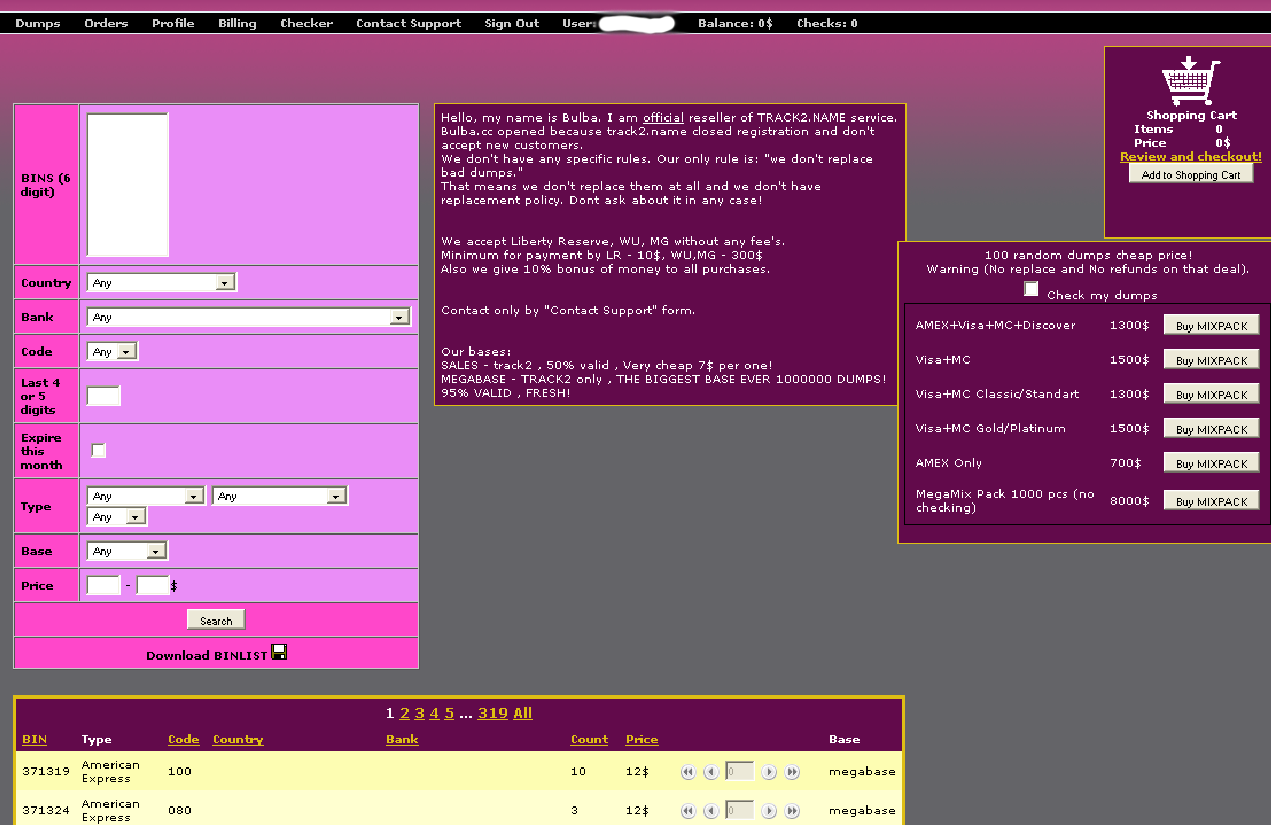
The Trial Exhibit List is amazing!  Forensic Evidence extracts from many of the restaurants involved, including Schlotsky's, Broadway Grill, Mad Pizza (5 locations), Casa Mia, Grand Central Baking, Village Pizza, Red Pepper Pizza.   Screen shots of the "Bulba.cc" and "Track2.name" webpages, including the order screen, and evidence of undercover purchases made in April 2011.  They seized the hard drives from a server hosted at Hop One's data center in Indonesia, and showed the log files for that server, as well as domain registration information for ncux.asia, ncux.tv, bulba.cc, track2.name, 2pac.cc, POSDumps.com, track2.tv, track2vip.tv, and track2.cc.  Many other emails showing that emails controlled by Seleznev were used to transact business related to all of the above were also introduced.  Posts made using the nCuX userid at Carder Planet, Carding World, Dark Market, and Carder.su were shown.  Transaction records, with IP addresses, for Liberty Reserve Accounts controlled by Seleznev were also provided.  Seleznev's laptop, iPhone, and iPad and reports of data from those devices were also provided, including a userid and password file (1Back14May.txt) and search histories and chat logs recovered from those devices.  The whole trial exhibits list is 23 pages long!

This screen shot from Bulba.cc was provided by Brian Krebs, in his story "Feds Charge Carding King in Retail Hacks" from July 2014.


The malware C&C locations from shmak.fvds.ru - located at 188.120.225.66, was where the Point of Sale malware was installed from.  According to the InfoSec Institute story, "Malware based attacks against POS systems", the malware used was BlackPOS, likely purchased from the hacker "Ree[4]" who is believed to be Rinat Shabayev, working on code developed by Sergey Taraspov.  In interviews with Russian media, Shabayev indicates that he modified and distributed the POS malware, Картоха, used in the Target breach.

While Seleznev is part of the Carders.su case in Las Vegas, the point of the separate trial was to address his use of Point of Sale malware to directly steal credit card data and sell it on websites that he created and controlled.  Just on the bulba.cc and Track2.name websites, from November 15, 2010 to February 22, 2011, Seleznev posted 200,000 credit card numbers and sold 140,000 of them, earning more than $2 million from the direct sale.

The rest of the dollar losses came from the forensic accounting that had to come next.  Given this list of cards, can we demonstrate loss due to fraudulent use of those cards.  For example, from page 10 of the indictment, just the cards stolen at the Broadway Grill -- over 32,000 cards stolen between December 1, 2009 and October 22, 2010 -- caused actual losses of $79,317.00 just at the Boeing Employees Credit Union there in Seattle, and losses to other banks of $1,175,217.37. 

Seattle Detective David Dunn, who we've written about in this blog before (See the Christopher Schroebel case), was the star witness in this case.  It was his forensics work at the Broadway Grill that started the case. By tracking the malware at the Broadway Grill, Dunn was able to then look for other Seattle properties that were also communicating to the Command & Control Server.  These turned out to include Grand Central Baking Company, four Mad Pizza restaurants, Village Pizza in Anacortes, Washington, and Casa Mia Italian restaurant.   Once Dunn realized the scope of the case, he referred other log file entries to other jurisdictions, working in his capacity as a member of the US Secret Service's Electronic Crimes Task Froce.   This led to the discovery of active malware in a Schlotzsky's Deli in Idaho, a Jewelrey store in Maine, Latitude Bar and Grill in NYC, Grand Canyon Theatre in Arizona, the Phoenix Zoo, Mary's Pizza Shack in Sonoma, California, and multiple locations in Evanston and Chicago, Illinois.

To make their case, the detectives, Special Agents, and prosecutors then had to compile all of those stolen cards and work with the financial institutions where the cards came from in order to figure out how many dollars in fraud were generated.  That's the process by which they demonstrated 3,700 financial institutions had lost more than $169 million in fraudulent charges based on the cards that Seleznev had stolen alone!

Operation Open Market

In addition to running his own exclusive carding sites as shown in the Seattle case, Seleznev was also a major player in a larger carding market known as Carders.su.   (SU is the country code for Soviet Union).  Operation Open Market is the Las Vegas case where many criminals have already been sentenced for their role in the carders.su website.  That case focused on Cameron Harrison, aka Kilobit, and 55 co-defendants, including Seleznev.  The investigation began back in March 2007 when an alert manager of a Whole Foods recognized Justin Todd Moss as someone who had used fake ID to steal from his store.  Moss turned out to be "Celtic", a seller of online ids.  Secret Service agent Mike Adams assumed Moss's online persona, and began selling counterfeit identifications to several of the people who have now found themselves in prison because of this investigation.  WIRED magazine's Kevin Poulsen has a great write-up on that aspect of the case.  (See: "The Secret Service Agent Who Collared Cybercrooks By Selling Them Fake IDs"). 

In total, at least 33 of the 56 indicted criminals have already been sentenced, although several, including at least two of the leaders, are still at large with rewards pending for their arrest.  Want to make some money?

Konstantin Lopatin, aka Graf, DOB 09/11/1982, Russian.  $1 Million reward:
 
www.state.gov/j/inl/tocrewards/c66446.htm

Roman Olegovich Zolotarev, aka Admin, aka DJ Goren, DOB: 10/20/1985. $2 Million reward
www.state.gov/j/inl/tocrewards/c66447.htm

The case was broken down into several trials. Case No: 2:12-CR-004 was specifically focused on the Carder.su activities:

Harrison, aka Kilobit was a 28 year old hacked from Augusta, Georgia, who was sentenced to 115 months in prison for his part in causing $50 Million in online identity theft trouble.  When he was arrested he was found to be in possession of 260 compromised credit and debit card numbers.  Seleznev possessed 1.7 million cards.

Alexander Kostyukov, aka Temp, aka KLBS, 29, of Miami - sentenced to 9 years on December 9, 2015

Jermaine Smith, aka SirCharlie57, aka Fairbusinessman, 34, of New Jersey - sentenced to 150 months on April 9, 2015

Makyl Haggerty, aka Wave, aka G5, 24, of Oakland, California - sentenced to 100 months on August 22, 2014

Michael Lofton, aka Killit aka Lofeazy, 36, of Las Vegas - sentenced to 24 months May 28, 2014 and 63 months on May 22, 2014 - he committed additional crimes while awaiting sentencing on the first case!

David Ray Camez, aka Bad Man, aka doctorsex, 22 years old - sentenced to 20 years in prison on May 15, 2014.


Case No: 2:12-CR-083 also was concerned with Stolen Identity Refund crimes against the IRS, but all of these were also members of carder.su:

Jason Maclaskey, aka Shinnerbock, aka That Guy, of Spring, Texas - sentenced to 10 years + 3 years supervised release on July 27, 2015.   Sentenced at the same time as Jason were Omar and Heather:

Omar Butt, aka Fear, of Brooklyn, New York - sentenced to 40 months on July 27, 2015.

Heather Dale, 25, of Grant Alabama - sentenced to 24 months.

Billy Steffey, aka Oink Oink, aka FredFlintstone, aka Yomamma,

Case No. 2:12-CR-084 included Thomas Lamb, Jonathan Vergnetti, Roger Grodesky, and John Holsheimer.

As more links to sentencing documents are found, we'll update this page.  In the meantime, to see which charges were brought against which vendors, please see "Operation Open Market: The Vendors"

Sunday, January 24, 2016

Vovnenko / Fly / MUXACC1 pleads guilty

Sergey Vovnenko pleads guilty

This week a Ukrainian hacker made famous for attempting to frame security journalist Brian Krebs by sending him heroin purchased on the Silk Road, had his day in court and chose to plead guilty.  Krebs blogged about his arrest in Italy in 2014 with the title The Fly Has Been Swatted, but now that a guilty plea has been entered, we can see the details of the case.

In June 2013, a U.S. Secret Service agent swore out a criminal complaint against Vovnenko for crimes he committed against citizens in New Jersey.  Although we refer to "Federal Crimes" in most cyber crimes, charges can only be brought for damages local to the U.S. Attorney's office where the prosecution makes the charges.


From 2003 until 2013, the complaint states, SERGEY VOVNENKO, AKA Centurion, AKA Flycracker, AKA Flyck, AKA MUXACC1, AKA Stranier, ran various scams related to carding.  In a specific instance, cards were stolen "on or about" March 14, 2011 from a victim in Rutherford, NJ, violating Title 18 Section 371 of the Federal Code.  Many of the early attacks used SQL Injection to gain access to target computers that were accessible via the web and had access to databases of personally identifiable information and credit card data.  Vovnenko in particular advertised "dumps" services using both his Twitter account and an ICQ account.

Between 2009 and 2011, Vovnenko managed to plant malware on computers at "Victim 1" which is described as a "global financial institution with millions of customer accounts" that "maintaned signficant infrastrucutre in New Jersey, including computer servers housing banking information located in New Jersey."

Vovnenko was an old-school carder.  He originally sold his dumps on the Shadowcrew website, which was shut down in 2004 by the U.S. Secret Service.  (This site is where Vovnenko began chatting with now infamous Data Breach king Albert Gonzalez.)  In 2008, Vovnenko used ICQ to chat with Vladislav Horohorin, the hacker known as "BadB."  BadB was sentenced to 88 months for trafficking in stolen cards and for his role in the $9M theft from Atlanta-based RBS WorldPay.  By 2010, Vovnenko was actively selling as "Centurion" on CardingWorld, Mazafaka, and Verified.ru.

Our complaintant testifies that on or about March 16, 201, Vovnenko chatted with another criminal who asked him to review his logs from his botnet to see whether he had IP addresses indicating that some of his bots were in the NJ-based Financial Institution known as "Victim 1" in the court documents.  He did, and was asked to plant an executable on that computer to give his co-conspirator remote control to the computer.  (We've heard about this type of "log selling", where a "commodity botnet infection" leads to targeted attacks at specific institutions before.  See my blog post about the Fox-IT/Group-IB "Anunak" report, "Botnets, APTS, and Malicious Emails")

A "Zeus Logs" seller offers 240MB of logs for $300-$400 ...

A Criminal Complaint is only intended to show Probable Cause to open an investigation.  It does not require the same level of details as an Indictment, which charges the accused of committing specific criminal acts.

The Indictment came in April of 2014 ...

The Indictment adds additional aliases (Tomas Rimkis, Darklife) and specific charges.  We'll focus on Charge One and Three, which are the ones he pleaded guilty to this week.

Count One:  Wire Fraud Conspiracy (18 u.s.c.§1349)
From September 2010 to August 2012, VOVNENKO and his co-conspirators "operated an international criminal organization that hacked into the computers of individual users and of companies in the United States and elsewhere, and used that access to steal data, including, among other things, user names and passwords for bank accounts and other online services, as well as debit and credit card nubmers and related personal identifying information.   After stealing the Log-In Credentials and Payment Card Data, defendant VOVNENKO and his co-conspirators used that information to illegally access and withdraw money from bank accounts and to incur unauthorized charges using the payment card data."  They also sold the data using online forums to individuals and groups that in turn did other illegal things with the data.

The indictment states that VOVNENKO had a botnet of "over 13,000 computers infected with malware" and that several of the infected computers were in New Jersey.  At least part of the malware was the "Zeus" malware that specializes in stealing banking information and recording keystrokes of users.  At least one employee (known as "J. H." in the indictment) of the Victim 1 bank had his workstation infected and from that base, the botnet was able to contact and interact with computers located inside financial institutions.  Counts Three through Six of the indictment refer to the specific acts of logging in to J.H.'s computer "in related to felony violations
18 U.S.C.§1349 and 18 U.S.C.§1030(a)(2)(C) and (c)(2)(B)(i)


By December of 2015, Vovnenko and his lawyers knew he was going to be found guilty on all charges, no ifs, ands, or buts.  They agreed to a plea agreement where Vovnenko took the rap for Count One and Count Three, agreeing that he could face a sentence of 20 years imprisonment and $250,000 fine.  Because he also faced the charge of Aggravated Identity Theft, there is an additional two year mandatory minimum sentence that cannot run concurrently with any other sentence.  Further, VOVNENKO understood that he may be required to pay restitution, and will likely be deported after his sentence is served.

Sentencing in this case is set to May 2, 2016.  At that time, a Money Judgement will also be made regarding the amount of Restitution that may be required.

Many more details about "Flycracker" (as he was known on Silk Road) or "MUXACC1" (as he was known on Twitter) are available from Brian Krebs' story "Hacker Who Sent Me Heroin Faces Charges in U.S."