Showing posts with label Investment Scams. Show all posts

Tuesday, May 02, 2023

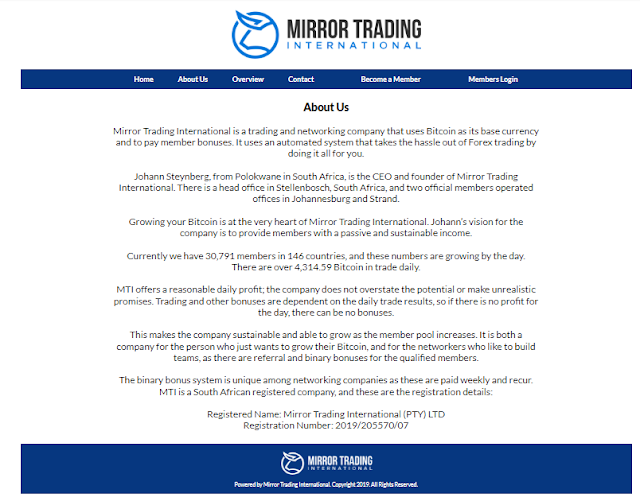
Mirror Trading International's Cornelius Johannes Steynberg and his $3.4 Billion USD Default Judgement

Some of you may have heard that students in UAB's Investigating Online Crimes class have been researching Crypto Investment Scam websites.  You can find a list of some of the sites we've identified so far on URLScan.io using our tag "CryptoScam" (as of this writing we have 3600+ sites on the list -- hosting companies and registrars, please take action!) 

Mirror Trading International and a $3.4 Billion Fine

You may have never heard of the U.S. Government agency, the Commodity Futures Trading Commission, but that doesn't mean they don't have power.  Last week the CFTC announced an order of default judgment against Cornelius Johannes Steynberg of Stellenbosch, Western Cape, South Africa. The order states that Steynberg must pay $1,733,838,372 USD in restitution and an additional $1,733,838,372 as a civil monetary penalty for defrauding 23,000 Americans of 29,421 Bitcoin.  (That's $3.4 Billion USD, or R63.6 Billion South African Rand.)

I'm proud to say that this action was brought in part by the Alabama Securities Commission, who joined Texas, North Carolina, and Mississippi in taking action.  I've met their director (who just retired this week! Thank you Joe Borg for 30 years of service!) and some of their investigators and they fight hard to protect the citizens of Alabama from fraud. 

Mirror Trading International claimed that their members could earn 10% per month in interest on their investments.  A typical ad of theirs boasted of this advantage over traditional bank accounts and other investment vehicles: 



Ponzi Scam or Affiliate Program: Tomato / Tomato

Like many other Crypto Investment Scams, MTI was an affiliate program.  MTI encouraged members to create an account, after which they would be granted an affiliate code. By sharing a link to the main MTI website using their affiliate code, anyone who clicked the link and made an investment would begin generating "passive weekly income" to the member. 

Dozens of webpages, Telegram channels, and Facebook pages were filled with ads claiming how easy it was to earn money.  Here's one that was shared on a Facebook page operated by affiliate "Themba2000." 


This affiliate regularly posted updates supposedly showing how much money they were earning, as well as testimonials where the people they had recruited supposedly thanked them for their newfound financial freedom:


Like many other Crypto Investment Scams, the affiliates were encouraged to share videos claiming that Artificial Intelligence-based training was part of the secret of their success: 


South Africa's Court Order Outlines a Problem: Greed

While the terms of the South African court order against MTI may seem like victim-shaming, Greed is truly one of the factors involved in many of these Crypto Investment Scams.


"People all over the world, and South Africans are no exception, are bewitched and fascinated by any idea or scheme promising, in most cases, instant wealth, new homes, new cars, holidays abroad and all material possessions that can be acquired with an abundance of money. A further attraction of these schemes is the perception that the money will keep rolling in with little or no effort by the participants, the hardest part being to count one's money." 

The conclusion of that case summarized their findings as follows: 

[137] MTI's business clearly amounted to an unlawful ponzi-scheme, i.e. a fraudulent investing scam promising high rates of return to investors and generating returns for earlier investors with investments taken from later investors. 

[138] It would appear that there is no pool of member bitcoin, Trade 300 does not exist, the artificial intelligence bot never existed or traded and the remarkable trading results presented to investors were prima facie false. 

(ordered by A De Wet, Acting Judge of the High Court) 

What?  The AI Magic Bitcoin Genie isn't real?  I'm shocked!

Scammers or Victims:  Why Not Both? 

Unfortunately, many of the people who became involved in the scam are innocent victims while others made fake Facebook accounts in order to scam others into signing up.  As long as they signed up others, they had a good chance of making money, until the whole scheme collapsed.  It took about five minutes to find fifty affiliates with a simple Facebook search:


So will everyone get their money back?  Highly unlikely. 

Steynberg Arrested in Brazil

Mr. Steynberg was arrested in 2022 by the Brazilian Military Police of the state of Goias: 

Assurances from MTI CEO Steynberg: I am not a Ponzi Scheme!

When Mirror Trading was first accused of being a Ponzi Scheme by the Texas Securities Commission, their CEO replied to queries using a form letter like this one, shared by Global Crypto in a story called "MTI Announces It Is Working With the FSCA": 

Dear Kratika,

I unfortunately only received your email this morning, Tuesday 14 July 2020.

As I have declared to the Texas Commissioner in writing, I wish to state and declare from the outset that Mirror Trading International (Pty) Ltd (hereinafter referred to as “MTI”), a privately held company registered in the Republic of South Africa, is not a Ponzi scheme (new money feeding old) or a scam, with which a holder of funds suddenly disappears.

It is also most unfortunate that because MTI is operating in the online passive income building industry, which has a notorious and demonstrated reputation for scams and Ponzi schemes, and, due to the nature and Modus-Operandi of the robust MTI referral-based business model, that MTI is automatically by default behaviour of the media and some regulators, and maybe the behaviours of some members, is being perceived by associative conclusion that MTI is but another of these.

This unfortunate and misinformed perception is far from the reality of what MTI is as a newly formed (15 month old) highly innovative referral-business and brand that the founders would like to see growing over many years into a global, iconic and heritage brand in the market trading sector.

For instance, the Texas Commissions states that …The actual value of the commissions depends on their success in recruiting new investors and multilevel marketers. … While this may apply to Ponzi schemes, this is not correct for MTI.

Daily trading returns using top regulated trading brokers determine the quantum of rewards, which can vary and if there is a negative trading day, there are no rewards. The point is that with MTI, that the funding of MTI referral payments is derived from daily trading profits and not from the funds of new members.

Another important point which differentiates MTI from Ponzi’s and scams is that members have full control over their funds (Bitcoin) at all times. Members are able to add or withdraw their funds (Bitcoin) at any time, with no complications and no fees. If you do research, you will find not a single member of the 75,000+ MTI members worldwide has ever complained or not been able to withdraw their BTC whenever they have opted to.  

It is the aim of MTI and its innovative, unique referral-based business model and MTI’s operating Modus Operandi of trading on world markets to generate real growth and returns on a daily basis, to work with and co-operate with regulators in every regard, in the process of taking MTI along a path that will see MTI fully and properly regulated.
There are three reasons for this.

1. My Founding Vision for MTI: Build a preferred iconic and heritage global brand in the financial services sector that delivers sustainable growth and value creation for all stakeholders, including for the little man in the street:
2. Professional and Compliant:  Ensure that MTI is a professionally managed business and brand that is regulatory compliant and which delivers sustainable growth and value creation for all stakeholders. My team and I are committed to this.
3. Change the reputation of the on-line passive income generating industry: We and myself personally, are extremely tired of this industry having a negative and darkly clouded reputation. And yes, some 99.9% of online passive income building services are scams and  / or Ponzi’s. I am personally very driven to be part of changing this perception once and for all, by showing and demonstrating to regulators, to the media and to consumers that such a business model can on a Bona Fida basis, exist, successfully operate and grow on an organic and sustainable basis, which is what MTI is doing.

To this end, MTI will in the coming period be placing great emphasis on engaging with and working with any regulator with a clear purpose at all times;  be fully compliant as a professionally managed company and brand that delivers sustainable growth and value creation to its stakeholders, and which intends to be around for many years to come.

MTI is already in discussion with the South Africa Financial Services Conduct Authority (FSCA) and will be meeting with the FSCA in a week’s time. MTI is also fully committed to co-operating with the Texas State Securities board and is in correspondence with them on this matter.

We trust that the above gives you some insight into MTI.

Should you wish to correspond further, please use my private email address: [REDACTED]
Your sincerely,

Johann Steynberg
Chief Executive Officer
Mirror Trading International (Pty) Ltd
South Africa


Monday, August 01, 2022

Please stop calling all Crypto Scams "Pig Butchering!"

 Lately there has been a media-driven craze in the fraud community to call every crypto-investment scam "Pig Butchering."  I hope you will join me in canceling that term after you read this article.

The term "Pig Butchering" comes from the Chinese term 杀猪盘 (Shā zhū pán or "butchering plate.") While the term has been used in Chinese media since at least 2018, it really became famous after the courageous actions of a human trafficking victim who was caught up in the game.

Hao Zhendong (郝振东) was recently divorced and had lost custody of his daughter as he was facing personal financial challenges and could not care for her.  During his time of desperation, he received a message from his uncle.  The uncle told him that he should come to Myanmar and join him at his work.  He claimed that Zhendong would be able to easily earn 60,000 to 70,000 yuan per month. 

Image from "Talking to Strangers" interview 

Late in 2020, Zhendong traveled to the Yunnan province of China where he paid smugglers to help him cross in to Myanmar.  After traveling with them for several days, he was forced to march through the jungle and up a steep hill for six hours.  When he arrived, he found he was in a work camp.  In his words, he says he realized he had "fallen into a wolf pit." The work camp was an industrial park where various call center employees worked scams. 

The northern region of Myanmar has four special zones, including "Wa State." So many Chinese people have moved to Wa State that Chinese is actually one of the official languages.  The corrupt local government, having no natural resources, opened their arms wide and welcomed criminal enterprises, which they call "foreign investors" to set up call centers. Under local law in Wa State, Myanmar, telecommunications fraud is not a crime. So many scammers have moved to the region that the government has even "rented" entire schools to be used as scam call centers.  The Myanmar government estimates that there are 140,000 Chinese living in the region, and that most of them are engaged in telecommunications fraud.  Similar to other forms of human trafficking, the men are only allowed to leave if they pay back the "investment" that their controllers have made in them.  The fee to leave ranges from 50,000 to 120,000 depending on how long you have worked. If you can't pay the fee after three months, you have six months added to your stay, with armed guards preventing you from leaving the work camp.  Many do go back to China, and enough go back with money for houses, cars, and a wife, that others are tempted into following in their footsteps.

Zhendong says that he often considered attempting to flee, but northern Myanmar is an "extrajudicial land" and Chinese people are regularly kidnapped and killed there with no consequence to their attackers.  One man who attempted to flee was forcibly returned to the camp, with the fingers on one hand amputated. 

In the work camp where Zhendong was enslaved, there were three buildings.  Two were dormitories and the call center was housed in the "Science and Technology Building." Each team was assigned to different topics.  Some worked lottery scams, others foreign currency exchange scams, naked chat / extortion scams, pornography scams, etc.  But Zhengdong was assigned to a "pig-killing gang." 

He was provided a manual which described his role.  His job was to target victims on the Internet and use emotions to convince them to invest their entire net worth in illegal online gambling.  His job as a "recruiter" for these scams was referred to in the manual as a "dog pusher" (“狗推” Gǒu tuī.)

He was provided three mobile phones and three "love story" script books.  His job was to find wealthy single or divorced women on social networks, and add at least two to his chat each day and build a romantic relationship with them online.  Once they were suitably "hooked" into his romance, he was supposed to turn them over to his team leader, who had 30-40 "dog pushers" under him to "kill." If the victim provided more than a million dollars, there was a celebration and the dog pusher was rewarded extravagantly. 

While he was learning the role, "the company" became very excited about a successful scam that one of the other dog pushers had accomplished.  He had convinced a young woman in Shanghai to invest her entire life savings - 2.92 million yuan - and when she realized she had been scammed, she committed suicide by jumping off a roof.  Another woman was convinced to sell her car and her house in order to invest more.  While the company thought these were great examples to emulate, Zhendong's spirit died.  He realized that he had to try to do something about this. 

On one point, his uncle had been telling the truth.  The company used cash bonuses as incentives, and each month they would spread millions of yuan on the table and pay out bonuses.  Some made the equivalent of hundreds of thousands of dollars in bonuses.  But Zhendong couldn't do it. 

He began sneaking up on the roof, using a stolen phone, and messaging his victims - explaining to them that he was enslaved and being forced to scam them.  Because he was failing to earn, his controllers were becoming very angry with him and his life was actually in danger. 

A potential victim, Yang Yu, changed things for him.  When he called Yang Yu to warn him, Yang Yu asked him "How can I help you get home?" In order to protect Zhendong, Yang Yu passed him money that he could give to his controllers as proof that he was working. Then Zhendong stole a list of victims from the company and urged Yang Yu to take it to the police. 

In February 2021, she took a list of 18 victims to the Anti-Fraud Center of Nanchang Public Security Bureau. 

Tao Jiangjiang, the leader of an Electronic Fraud task force who helped Zhendong get home

Tao Jiangjiang began to communicate with Zhendong and a rescue mission was arranged through the Yunnan police, working with an informant in Myanmar.  Despite being advised not to take any risks by Tao Jiangjiang, Zhendong felt that he could not leave empty-handed.  He worked to observe the password his Pig Killer boss used to log in to the company server and late one night logged in and wrote down as many names as he could.  When he arrived back in China, he had a list of 105 additional victims with him who were contacted and assisted by the Chinese police. 

There was a dramatic event at the China-Myanmar Nansha Port when Zhendong recognized a man from the company chasing after him.  When armed Chinese police took custody of Zhendong, the company man backed off. After this, Zhendong did many media interviews, some alongside the Electronic Fraud police, which helped to popularize the term "Pig Butchering." 

While there are definitely "Dog Pushers" and "Pig Killers" who are targeting the Chinese ex-patriat community, unless your scammer is speaking Chinese from a call center in Myanmar, you may be a fraud victim, but you are not a victim of "Pig Butchering." 


The main sources for this story were the Chinese versions of Zhendong's misadventure, especially these two: 

荐见 | 反水、救赎、卧底:逃出缅北“杀猪盘”

(Rebellion, redemption, and undercover work: escape from the "pig killing" center in northern Myanmar - an article by “荐见美学” ) 

and

误入杀猪盘团伙后,他偷出了105名受害者名单丨和陌生人说话

("After accidentally entering the pig killing gang, he stole a list of 105 victims" in the TenCent column, "Talking to Strangers" - if you speak Chinese there is a great interview here!) 


Tuesday, March 22, 2022

BEC Still #1, but Investment Fraud passes Romance Scams


https://www.ic3.gov/Media/PDF/AnnualReport/2021_IC3Report.pdf


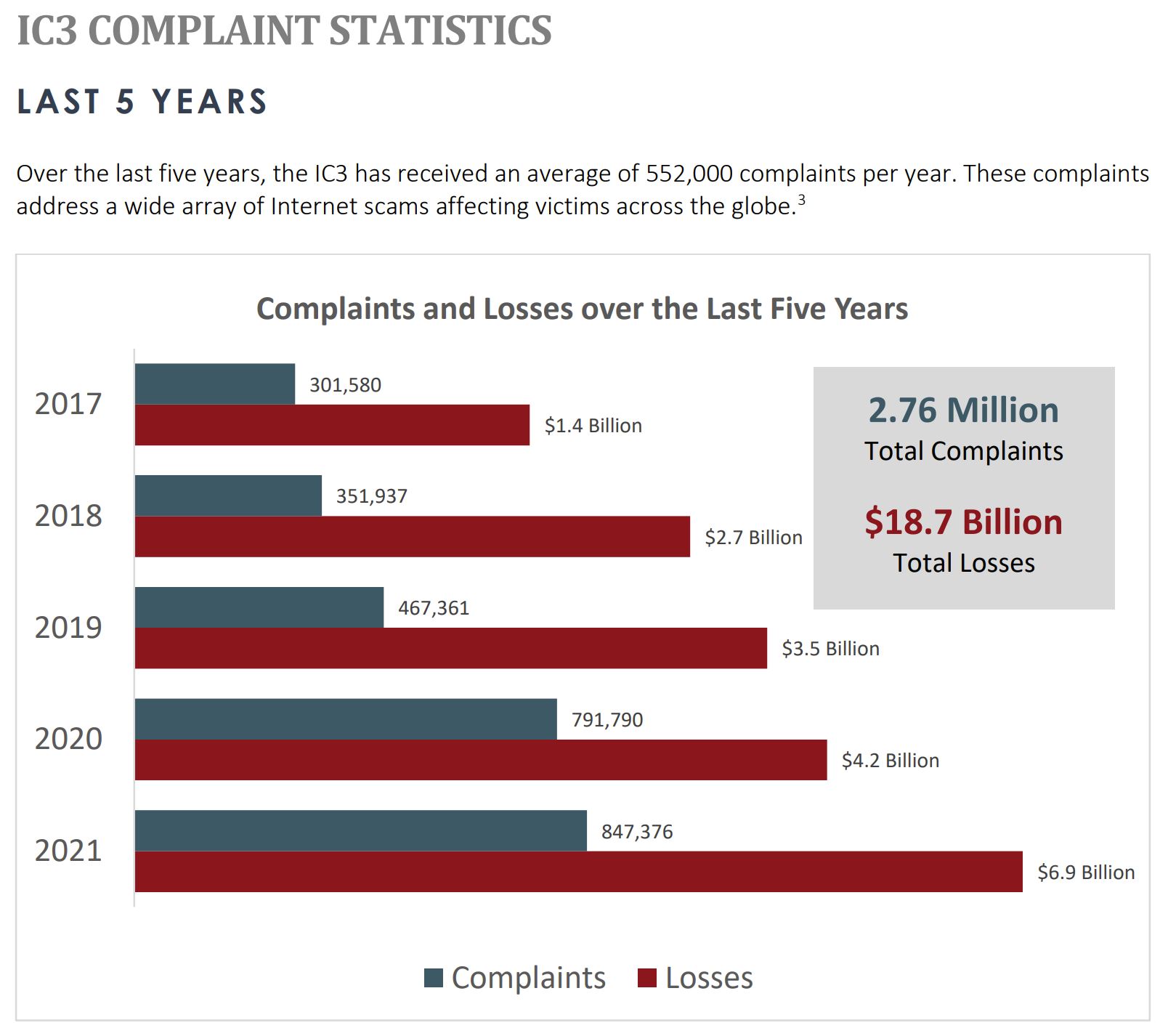
The FBI's Internet Crime Complaint Center (ic3.gov) has released their 2021 Internet Crime Report.

The number of complaints increased by 7% to 847,376 from 2020 to 2021, however the reported losses increased by 64% year over year to $6.9 Billion!


For several years, the #1 Cybercrime type has been Business Email Compromise followed by the #2 of Romance Scam. But this year, we had a change!  The criminals have discovered how many people don't understand investing in cryptocurrency and have turned Investment Scams into a new money factory. 

#1 is still Business Email Compromise, but with only a 3% increase in victims, there was a 28% increase in reported financial losses.  That's an average loss of $120,000 per victim, compared to last year's $96,700 per victim. 

#2 dislodges Romance Scams by Investment Scams for the first time ever with a dramatic increase!  Investment Scams went from 8,788 complaints to 20,561 complaints, while losses increased 333% from $33.6 Million dollars to $1.45 Billion dollars!  THat's an average loss of $70,810 per victim, up from $38,287 per victim last year!

#3 Romance Scams was quite similar to 2020 in the number of complaints, however the amount of losses still increased by 59%.  In 2020, the average victim lost $25,272, but in 2021, the average victim lost $39,344.  And these victims tend to be senior citizens! 

Crime Type 2021 Losses2020 LossesChange in Loss2021 Victims2020 VictimsChange in Victims
BEC/EAC $2,395,953,296$1,866,642,10728%19954193693%
Investment $1,455,943,193$336,469,000333%205618788134%
Confidence Fraud/Romance $956,039,739$600,249,82159%24299237512%
Personal Data Breach $517,021,289$194,473,055165%518294533014%
Real Estate/Rental $350,328,166$213,196,08264%1157813638-15%
Tech Support $347,657,432$146,477,709137%239031542155%
Non-Payment/Non-Delivery $337,493,071$265,011,24927%82478108869-24%
Identity Theft $278,267,918$219,484,69927%516294333019%
Credit Card Fraud $172,998,385$129,820,79233%1675017614-5%
Corporate Data Breach $151,568,225$128,916,64818%12872794-54%
Government Impersonation $142,643,253$109,938,03030%1133512827-12%
Advanced Fee $98,694,137$83,215,40519%1103413020-15%
Civil Matter $85,049,939$24,915,958241%111896815%
Spoofing $82,169,806$216,513,728-62%1852228218-34%
Other $75,837,524$101,523,082-25%123461037219%
Lottery/Sweepstakes/Inheritance $71,289,089$61,111,31917%59918501-30%
Extortion $60,577,741$70,935,939-15%3936076741-49%
Ransomware $49,207,908$29,157,40569%3729247451%
Employment $47,231,023$62,314,015-24%1525316879-10%
Phishing/Vishing/Smishing/Pharming $44,213,707$54,241,075-18%32397224134234%
Overpayment $33,407,671$51,039,922-35%610810988-44%
IPR/Copyright and Counterfeit $16,365,011$5,910,617177%427042131%
Health Care Related $7,042,942$2,904,2515-76%5781383-58%
Malware/Scareware/Virus $5,596,889$6,904,054-19%8101423-43%
Terrorism/Threats of Violence $4,390,720$654,7449-33%1234620669-40%
Gambling $1,940,237$3,961,508-51%3953911%
Re-Shipping $631,466$3,095,265-80%516883-42%
Denial of Service/TDoS $217,981$512,127-57%11042018-45%
Crimes Against Children $198,950$660,044-70%21673202-32%

Investment Scam Examples

What does an Investment Scam look like?  The most common ones these days are promising a guaranteed rate of investment. Thousands of such Investment Scam sites have been created and most of them are being pushed on social media.  People who claim to be successful on the sites are often only trying to earn a commission by referring others to the site.

It only took a couple hours to find more than 500 live Investment Scam sites last month.  Many of these sites are still live today.


Many of the sites are unlikely to attract real investors because of how ridiculous their rates are.  No one believes that they can earn 50% per hour ... however this site promises that if you can trick your associates into investing, you'll get 5% of whatever they deposit.  This is quite common. 

Crypto-Trades[.]uk 

A more believable site promises a much lower rate, such as 3% per day for investments up to $4,999 dollars.  If the site owners believe they have a big fish, they may actually PAY the 3% for a small investment, using that as proof that the system works in order to lure a larger investment.  This site, and many like it, then offer 6% daily profits for investments of at least $5,000, or 9% daily profits for investments of at least $30,000. 


The site pictured above claims to be "Crypto-Trades[.]uk" and offers proof of their legitimacy by providing a link to their "Certificate of Registration."

Crypto-Trades dot UK
claiming to be the British Corporation, "Crypto Ltd" which is a real company, just not them. 


They are regularly abused in that way.  CryptSparkFX[.]com, Crypto-binary[.]com, CryptoTrust[.]ltd, CryptoAlphas[.]uk, CryptoHive[.]uk, Webull-Investments[.]com, ExploreFX[.]uk, Crypto-Gain[.]ltd, Slushpool-investment[.]com, Intrex-invest[.]com, and FedelityFunds-Crypto[.]com are some of the other Investment Scam sites that use their address, hoping to gain credibility from it. 

Intrex-Invest[.]com

FedelityFunds-Crypto[.]com

Slushpool-investment[.]com

CryptoHive[.]uk

A True Victim Story

A successful businessman in my area came to me to ask for help.  He had originally joined a group such as those above called CryptoHood[.]io which later became CryptoHood[.]co.  He invested a small five figure number on their site, and got scammed, losing it all.  When he was complaining about being scammed, someone in a Facebook investment group let him know they too had been scammed by those people.  But good news!  He had found a legitimate company that really paid out!  EasonFXPro[.]com! Because he had been burned already, he put in a smaller investment this time.  $2,500.  An amount that this CEO "could afford to lose."

The scammers let him know that because he was a VIP investor, they were going to let him use their "special" app, so that he could watch his trades in real time.  The theory was that their advanced Artificial Intelligence was doing Bitcoin trading to make amazing profits.  The app they used was in the Google Play store ... but the VIP version was only available via their special URL.  They convinced him to download the app from "blockchain.en.uptodown[.]com/android/download/2264221." That was his "personalized" version.  He was truly amazed by the bot, and could enter "his" bitcoin address into any blockchain explorer to see his earnings.  (We checked the address, and it was doing HUGE volumes of small transactions ... it just wasn't his wallet.   He was led to believe that the transactions were "the AI doing trades" for him.  Within a couple months, his bitcoin address had funds worth nearly $250,000!  So he decided to cash out.

In order to cash out, he just had to pay them a "Sigma Fee" of 10%.  He refused ($25,000!?!?!?!) 
They then offered to let him withdraw just $50,000, for a Sigma Fee of only $5,000.
He was harassed on the phone for a while by "Elizabeth Frances" and "Evelyn" and "Mark Gerrard" and "Steven Williams" but chose to file an IC3.gov report about his experiences and walk away from Crypto Investments for a while.

The Appeal of Easy Money

With 1100 "likes" it must be real, right?

And they provide screenshots as proof that they are really getting paid!  So, it's guaranteed, right?